Thank you to everyone who helped to give some responses to my questions! I truly appreciate your feedback :)
Tuesday, 10 March 2015
GAFE and Implementing Gmail Research
Here is the Storify of our discussion last night around implementing Gmail and other apps from the GAFE platform.
Thank you to everyone who helped to give some responses to my questions! I truly appreciate your feedback :)
Thank you to everyone who helped to give some responses to my questions! I truly appreciate your feedback :)

Sunday, 8 March 2015
Social Media Organising Workshop: PPTA Issues and Organising Conference 2015
Such an awesome opportunity today. Thanks to Derek Morris for putting us in the programme, to Adele Towgood who suggested I do a workshop on Twitter and most of all to Jason and Georgie who let me tag along in their workshop :) Nga mihi nunui ki a koutou :)
Will do a reflection later on - but here's the Storify collation of the Tweets :)
Will do a reflection later on - but here's the Storify collation of the Tweets :)
The Power of the Shoulder Tap
Last night I was talking to my mates about wanting to be PPTA President in the future. My friend looked a little surprised. He's been in the PPTA longer than I and has some amazing knowledge on ...basically everything. While dancing to music this morning... I kept thinking, why should he have been surprised though? Haven't I seemed ambitious to him? I've been relatively busily involved with PPTA over the past year. Am presenting a workshop with my peers at this year's Issues and Organising conference on Social Media Organising. I've been sent to Brisbane as a delegate of the PPTA for a New Educators Conference. I've helped build up the Establishing Teachers Conference by organising it and promoting it in it's most dire hour of need.
Is ambition not as clear cut as I once thought?
When I was at high school - I organised various boycotts and joined in with PPTA on teacher strikes. I have always been about the power of the collective voice. I have always fought for the underdog and know that everyone deserves fair representation.
Perhaps though - others see ambitious people as more cut-throat. They tend to throw others under the bus and basically do anything to get where they want to be.
I actually don't think that is ambitious. Sure, it is ambitious in it's inherent nature. But what's more important is that you work hard. You build a name for yourself and people believe in you that you'd do a good job. Sometimes you have to make difficult decisions on what is actually going to be beneficial for you as an individual person, but... I actually don't think there is a need to whakahe anyone else in order to further push yourself up.
If anything - I'm a quiet observer. I will talk when need be and I often have strong things to say when I do. I'm vocal on a range of issues relating to teaching and wouldn't have been so quickly vocal if I hadn't have been exposed to the world of my PLN on Twitter.
To me ambition is doing the things others don't really want to do. Like hold meetings and taking the minutes. Talking with the kuia and koroua and learning from the very best. Being taken under the wing and mentored to a place where you know it will be right for you.
This weekend was the second time I was told by one of my mentors that it's the power of the shoulder tap. That opportunties come this way and it's important to look at that person who brings it, right in the eye and decide whether you can trust them. Because if you trust them, that in all honesty they believe in you, that you can do the job, then you should believe in yourself to be able to do it too.
To me - that's ambition.
So perhaps - when all is said and done... stand up for who you are and have those dreams and aspirations, stay true to your values, but remember - the others who watch from afar are wondering whether your ambition is self-serving or will benefit the needs of the many. Because that's what it's all about right? Having the power to choose to do good, every day.
Is ambition not as clear cut as I once thought?
When I was at high school - I organised various boycotts and joined in with PPTA on teacher strikes. I have always been about the power of the collective voice. I have always fought for the underdog and know that everyone deserves fair representation.
Perhaps though - others see ambitious people as more cut-throat. They tend to throw others under the bus and basically do anything to get where they want to be.
I actually don't think that is ambitious. Sure, it is ambitious in it's inherent nature. But what's more important is that you work hard. You build a name for yourself and people believe in you that you'd do a good job. Sometimes you have to make difficult decisions on what is actually going to be beneficial for you as an individual person, but... I actually don't think there is a need to whakahe anyone else in order to further push yourself up.
If anything - I'm a quiet observer. I will talk when need be and I often have strong things to say when I do. I'm vocal on a range of issues relating to teaching and wouldn't have been so quickly vocal if I hadn't have been exposed to the world of my PLN on Twitter.
To me ambition is doing the things others don't really want to do. Like hold meetings and taking the minutes. Talking with the kuia and koroua and learning from the very best. Being taken under the wing and mentored to a place where you know it will be right for you.
This weekend was the second time I was told by one of my mentors that it's the power of the shoulder tap. That opportunties come this way and it's important to look at that person who brings it, right in the eye and decide whether you can trust them. Because if you trust them, that in all honesty they believe in you, that you can do the job, then you should believe in yourself to be able to do it too.
To me - that's ambition.
So perhaps - when all is said and done... stand up for who you are and have those dreams and aspirations, stay true to your values, but remember - the others who watch from afar are wondering whether your ambition is self-serving or will benefit the needs of the many. Because that's what it's all about right? Having the power to choose to do good, every day.
Saturday, 7 March 2015
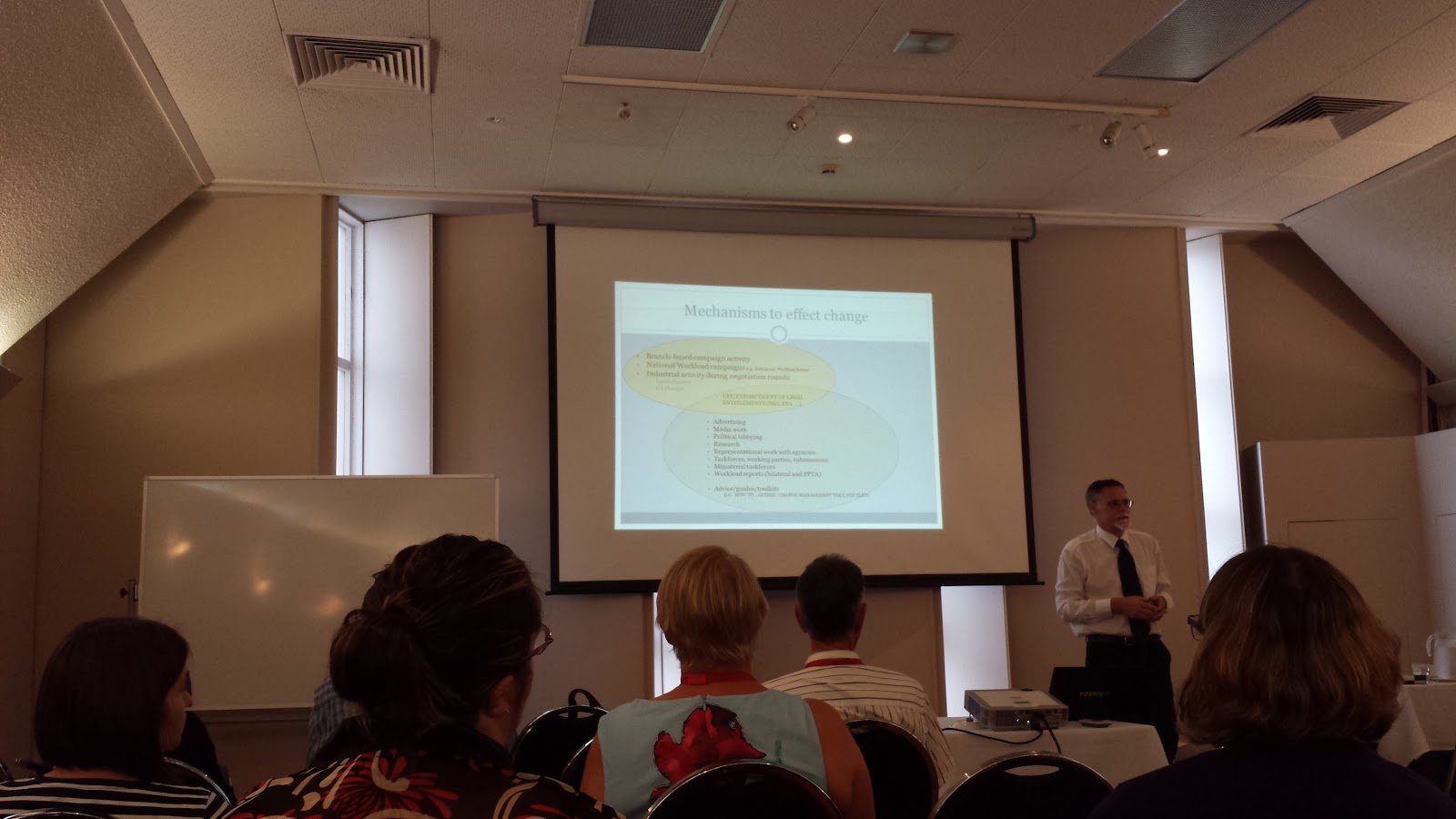
Organising Around Workload - Blair O'Brien: PPTA Issues and Organising 2015
Organising Around Workload
Blair O’Brien (Field Officer)
Brainstorm
Success Stories
What Lead to Success
Success
How?
Rest breaks - 2000
solidarity, education
Not covering relief. Timetabling policy
Compensation. Negotiate a sensible way of putting it into the timetabling policy. Research, membership density
Non Contact: days off? Duty Relief?
Principal support,
Winning
For an issue to be won it needs to be:
Deeply felt
Widely held &
Winnable (pick your fights)
Add evidence
Issues
Brainstorm issues at a local or national level that are:
Deeply felt
Widely held &
Winnable
PLGs and Academic counselling, initiatives not done or done well, Inquiry PLGs, Pastoral Care blowout, internal assessment, assessment worse since alignment, data gathering, ensure that we have lists of at-risk students, committees, multi-level classes, individualised programmes, class sizes, form/whanau time, tech expectations, appraisal processes change, duties, study session which is not counted as contact, pressure for results to be better, expectation to take extra classes for scholarship students, building a culture - what are you taking out?,
Change Management toolkit - fab way to talk professionally with management
Health and Safety legislation for Science class sizes. Endeavour means that they need to tell you why it can’t happen
Solutions
Meetings
Legislation; Consultation, Health and Safety
Industrial Action
Moratorium of initiatives. Initiative-itis. If it's not improving student learning and achievement then why are we doing it?
PLD Toolkit is also important!!!!! Check it out.
Consultation
Health and Safety officer at every school.
Resources:
Handouts
- Workload provisions
-Consultations
www.ppta.org.nz
Health and Safety
Workload Protections - A Quick History of Provisions: Rob Willets - PPTA Issues and Organising Conference 2015
Workload Protections - A Quick History of Provisions
Rob Willets
1991 - Codification
- Any non-contact time by grace and favour and practice of school
- 23 hrs pw teaching common but could be 25
- First yr teachers could teach up to 20 hpw
- No class size constraints
- Te Atakura grads from 1987-1990 recieve a time allowance
- Taching wk 10 half days (effectively 25 hrs)
- Teaching yr 380 half days
Claim and campaigns
- workload
- class size
- mac contact time
- max classsize
- max 500 student hpw contact claim
- Max hrs per year claim
No movement on provisions in the 1990s but pressure built up to address workload issues.
1996 STA settlement
PLD call-back when school closed for instruction limited to 5 days p.a (w reimbursement consts)
1999 STCA settlement
Limit call-backfor admin when school closed for instruction
2000 SSRG
School Staffing Review Group 2000 - PPTA secures 1,800 FTTE extra staffing for sec and area schools - sufficient to resource 20 hrs max contact and an hr per unit
2001 claim for max contact time of 20 hrs
Mallard “over my dead body” - PPTA members decide this is the scenic route
Significant industrial action 2001-2002
2004 STCA
From 2006 min 5 NC hpw for full-timers
Y1 - 15hpw contact time
Y2 - 17.5 hpw contact time
1hpw per permanent unit (up to 3)
Table of min non-contact hpw for part-timers 18hpw and above (not prorated)
Medical retirement
Sabbatical scheme
2011 STCA settlement
HoDBTTA extended - 1hpw per Y2PRT with BTTA
Ten new 10 wk senior manager sabbaticals pa
Sec sc staffing review group
2012 Staffing Cuts Fight
Govt policy to cut staffing and increase class sizes at junior levels reversed. “90% of schools will lose or gain no more than 1 FTTE”
- Resourcing
- Information
- Lobbying
- Political
- Media
1990-2015 Claw Backs
There have been aggressive employer claims around workload during industrial rounds in the 1990s and since 2007
etc
Next phase 2015-2018
Claims dev process
- Teacher Workload Taskforce - What is the most effective change to make to fix the workload problem? We need to have a really good idea of what our individual issues are with workload and think about what the symptoms and solutions are for these.
- Review of Work of the Middle Manager
- Media work
- Political activities
- Lobbying
- Representational work
- Use of other legislation (eg. H&SA)
2016/17/18 claims - Need to start thinking about future claims and process within this
Human Rights and Stress in the Workplace: Yvonne Oldfield - PPTA Issues and Organising Conference 2015 - Workshop
Human Rights and Stress
Yvonne Oldfield
Are Labour Rights Human rights?
Normative - something that is inherently right, has a moral force or absolute value
Something you don’t have to bargain for or fight for. A normative right is something that is a given.
“A human right is not earned or legislated into existence and cannot be bargained away… it attaches to the very fact of being human.” (Hugh Collins/Virginia Mantouvalou)
Moral weight - health and safety goes to issues of survival.. a facet of … “inalienable facet of life.”
Universal application - must apply to everyone. We are all workers or potential workers
Stringency and timelessness - accept that no activity can be entirely risk free
Uni of Dec on H R (1948)
Right to work (article 23):
- Everyone has the right to work, to free choice of employment…
International covenant on Economic, Social and Cultural Rights
- Right to work
- Right to safe and healthy working conditions
- social security
- etc
Health and Safety and the ILO
- Millennium Dec… Decent Work Agenda
- Seoul Dec (2008)
- Safe and healthy work environment - human right
Defining the right -
“The right to work in an environment reasonably free from predictable, preventable, serious risk” - Spieler
What does this mean in practice?
- stress: personality differences, the idea that you are to blame,
- physical: short and having to stand on tables,
- workload:
- Communication breakdown: SMT to Staff, HOH and Teachers, Teachers to Teachers, holistic
- Extra-Curricular and Extra Opportunities for Ss. Expectation that you should do it.
- responses put us at risk, “teacher just needs to harden up”,
- Unacceptable behaviour
- Feel stressed when our response taps into physiological and psychological stress
- Situation will affect everyone differently -
- Minimise risk -
Difficult to define the expectations and the responsibility and blame for stress.
The need to have a Health and Safety rep at school.
The need to have support networks
Boards should have a policy.
Process needs to be really clear: identify hazard or problem - who to talk to - knowledge that they’re going to deal with it.
What are the key elements of the right?
- Predictable?
- Preventable?
- Serious?
Who are the “duty holders” - who is responsible for ensuring that this right is upheld?
- Everyone -
- ERO - identifying that conversations
Elements of the right:
- Rights to information about the dangers on the job (goes to worker control/informed choice)
- Freedom to protest or refuse work (level of risk may change over time, or new information become available)
- Worker participation (Robens model predicted on full engagement by workers)
Discussion:
For new teachers this is HUGE. We feel too scared to say that we’re overwhelmed because we’d be looked as if we were incompetent.
Not speaking up. Scared you’ll lose your job. Lost to the profession. Not compensated. We’ve lost teachers from heart attacks. Stress can be fatal.
Stress in Teaching:
Teaching has always been considered stressful - research by England’s Health and Safety Executive, found it to be one of the most high-pressure careers, with 41.5% of teachers reporting themselves “highly stressed”. www.the guardian.com/education/2012/dec/26/teachers-stress-unions-strike
The Role of the State: monitoring and enforcement:
Maastricht Guidelines: States must acknowledge legitimacy of rights and meet obligations to:
- Respect (don’t undermine workplace safety)
- Protect (set standards to prevent violations by third parties) and
- Fulfil (monitor/administer/enforce to ensure the realisation of rights).
What are the health and safety issues for teachers?
Specifics on Stress:
- increased workload
- being asked to now perform extra initiatives beyond training (academic mentoring, guidance counselling, negotiators, policing students)
- expectation of being available 24/7
- fast paced initiatives that don’t really change anything though they are pushed out as if they will change everything
- diversity of student behaviour - expectation to fix it
- personalising of programmes
- HOD - extra legislation to ensure..
- Middle Management and senior mngmt are sometimes bullies, tell you to suck it up, build a bridge and move on
- PPTA expectations and having to fight for our rights as teachers and as workers
- Data gathering
- ADMIN: academic tracking sheets
- Building portfolio for appraisal
- Engendered by increasing vulnerability of fixed term contract, casualty of the workplace
- constantly having to be on top of behaviour
- Restorative Justice: restorative chats to get things sorted, missing out on breaks, becoming seen as a bad teacher for taking your breaks
- Can’t say NO. The mechanism for relieving stress is creating stress
- Under more pressure to keep up with tech and expectations of the digital load
- Erosion of work/life balance
- Mentoring -
- LACK of TIME.
- Time pressure
- Given an extension of form class to do academic counselling - track it on KAMAR. Checking up on us for not doing our job
- Hekia saying we need to raise the bar all of the time and what we need to achieve
- Summer school
- Extra classes, more credits, “Can’t you find a Unit Standard for them to do during the holidays?”
- If you follow procedures, sometimes it doesn’t work and then it’s not followed through.
- The tension of when a teacher can reasonably say NO. Or question the situation.
Who?
- Govt?
- BOT?
- PPTA?
Information is a key issue. But if you don’t know where to go with it or whether it will be followed up - then what will happen?
What is workplace stress?
- “work-related stress is the response people may have when presented with work demands and pressures...which challenge their ability to cope.
- Stress occurs in a wide range of work circumstances but is often made worse when empoyees feel they have little support from supervisors and colleagues as well as little control over work processes
- There is often confusion between pressure or challenge and stres and sometimes it is used to excuse bad management practice.”
Solutions:
Survey to be created and sent out to branches
Workload Taskforce: paper version has been done. Digital survey to be created and all schools will be doing it this term. Encourage your colleagues to do it.
Need to tie in consequences. Need to show the outcomes of people with health issues.
What are the health issues that flowed with stress levels.
Need exit surveys when people leave schools.
What might a safe system of work look like?
How can we:
Prevent (Eliminate)?
Reduce (Minimise)?
Manage?
Cope?
With stress and violence in schools?
OUR thoughts: It is too individualised. Those who have the stress need to say that they’re stressed and feel comfortable in their workplace to be able to do so. Access the tools available to them individually.
The main problem is that people don’t feel able to stress out.
Group discussion:
When new initiatives are introduced - a RAMS audit should be done. If staff were consulted then risks would be reduced. Something has to be taken off. Layer upon layer upon layer. “What is this replacing?” You may only do it for a couple of years (the money is gone) and all of your hard work is gone. How are you going to show that it’s working?Measure effectiveness. Need to measure effect of initiatives. Never any evaluation of the initiatives brought in and how effective they were.
More support needed for eLearning. Include use of volunteers. What is effective of modern learning?
Abide by the contract.
Nurse/other specialists not able to help staff.
Limits on work time - start by measuring hours.
Preventing stress in schools…
- develop a constructive workplace culture based on decent work, professional respect, basic health and safety principles, tolerance, equal opportunity, and quality of service
- Promote a culture of school or organizational healthiness - redesigning work, ergonomics, teacher training and counselling to assist teachers in coping
- Implement safe schools policies and programmes including clear statements that violence will not be tolerated, and
- Recognise and assess serious student behaviour issues; intervene, monitor and evaluate
Handbook of good human resources practices in the teaching profession, ILO, Geneva 2012
Subscribe to:
Posts (Atom)