Showing posts with label learning. Show all posts

Sunday, 22 March 2020

2020: Pandemic Planning

Pandemic

Adjective:
 (of a disease) prevalent over a whole country or the world.
synonyms:widespread, prevalent, pervasive, rife, rampant, epidemic;

Noun:
an outbreak of a pandemic disease.
"the results may have been skewed by an influenza pandemic"

I really didn't think we'd be getting right into Pandemic Planning at kura so early. I thought maybe we'd hit global Zombie Apocalypse first... but no. This is real.

I was in a state of panic yesterday.

I spent a lot of time in bed - worried, concerned. Sleepy.

Today, I got back into action mode. Lots of things were completed at school but there is still this overarching sense of impending doom to calculate and maneuver around.

My current thoughts are a resounding: We got this! But my internal conflict says... Do we? Like actually, do we?

It makes me think about how lucky we are here in New Zealand. We'd heard about it late last year, on into the beginning of this year.

One of my Y12 students even did her speech on this subject. Only slightly ironic that we'd then have a global pandemic on our hands...

Still, all the planning in the world couldn't prepare us for this. At present we have sixty-six confirmed cases of Coronavirus. This man in the video below is so clearly spoken, so relaxed and calm in this growing sense of panic that the rest of us are feeling. People are panic buying toilet paper. TOILET PAPER. Yes.... And not just here, either. All over. Sure, hand sanitiser and bleach sold out quickly too. They've only recently put a limit on how many loaves of bread you're allowed to buy. My friends are having trouble buying bags of flour. It makes me a tiny bit more appreciative of being gluten free.

Underneath all this bravado and my own sense of supposed calm. There is an overwhelming worry and concern for the people I love and care for. My immune-compromised colleagues are allowed to work from home this week according to Ministry of Education and Ministry of Health guidelines.

We're at Pandemic Alert Level 2 here in NZ. Our schools won't close until we are at Level 4. This is in itself quite a stressful time. We are on the frontline: teachers, nurses, doctors.

What are the symptoms again?

Coronavirus has spread fast. From Wuhan, China and then on throughout the rest of the world. We closed our borders relatively quickly. Thankful to have the cousin Jacinda as Prime Minister. She has truly helped keep the virus at bay. People traveling were meant to self-isolate. I'm guessing the 66 cases are people who did the travelling.

We are yet to move to community transfer. When that happens... I guess we'll be rising to the next Alert Level.

Italy has become the new epicentre of the virus. It is awful to think of the beautiful places I travelled to and visited in 2018 having their beautiful people getting sick and dying from this disease. Apparently the canal waters are clear. The sediment has not been disturbed. Fish and swans can be seen in and on the canal waters. Even dolphins have returned.

Some are saying that this is Mother Nature's way of putting us all into a time-out. Perhaps this is true. We were going to end up this way at some point, why not now?

It's hard to say what might happen next.

All I do know is that I have to keep a calm face and encourage my colleagues to do the same.

We're all in this together. Solidarity. Sick?

Whatever it means - we have to keep moving.

It is scary though to think of my students getting sick and coming to school, sick and then that virus transferring to others.

Usually when I start thinking of next possible situations, the worst possible situations, I feel a sense of dread, panic and fear.

At least with this pandemic of Coronavirus... I know the realities. Everyone I know and love could die. This might be a really morbid thing to say - sure. But I've actually never felt more calm. Because this is literally the worst thing that could happen.

And yet, I think the panic lies in what to sort out first. Which priority is more important?

Which task on my to-do list needs to be actioned first?

To Do...


  • Ensure all classes in my department have Google Classroom set up
  • Ensure that all students have access to wifi, data or other means to complete their work
  • Check in with the immune-compromised teachers in my department. Are they okay? Will they be working at home this week? 
  • Talk with immune-compromised students via email. Check that they are ready, and set up for learning at home
  • Reassure students and teachers that it will be okay... 
  • Find out more information of how dogs can get sick from the virus... 
  • Buy more echinacea tablets ---- don't be overwhelmed if you can't find any...
  • Try not to panic buy....
  • Talk to Nan often and see how she's doing
  • Create Zoom lessons and use Screencastify
  • Prep resources that can be used online and offline
  • Talk with students and check they're prepped at home with food and safe places
  • Carry out duty at school -- enforce 2 metre separation where needed


Tuesday, 17 December 2019

Whiteness

It's something I've talked about previously. It's something I've discussed at great length with my lecturers and professors at Waikato University. It's something I've mentioned to other white-passing Māori friends/colleagues of mine too. 

Yet, it's still happening. 

My whiteness. 

My beautiful, olive skinned complexion. 

My whakapapa running through my veins. 

My feet resting firmly on the shoulders of my tupuna. 

I'm lifted up. 

But yet, it's somehow not enough. 

I know my ancestors would be proud of me, how far I've come. 

How I recognise all aspects of my whakapapa. 

How I travelled and pilgrammaged to Prague, Guernsey and waahi tapu throughout Te Rohe Potae in the past year. 

Yet, I was asked a question during my appraisal hui whether my struggles this year getting my leaders in my bi-lingual class, and therefore the rest of the students, to accept me, might have had something to do with my whiteness. 

But I know that not all of their teachers are "visibly Māori" as my appraiser put it. 

We've discussed this issue here on this blog at length. 

We've discussed my need at eight years old to do a haka on my grandfather's dinghi. 

I've shared and shared and shared the plethora of strategies I've used to belong in the classroom, to have success as Māori in the classroom but also and most importantly, to feel safe in the classroom. 

Because our learning spaces are not just for our students. They're our workspaces too. We need to feel safe in ourselves there too. 

Yes - I am white. My grandmother asked me last year whether I knew that. I looked at my skin and said, "Yes, I know I'm white. But I'm also French, Irish, Scottish, Czech, etc AND Māori too." 

At that time she had shared some frustration with the fact that I'd made a joke to my sister about there being a dead hawk in the freezer that she couldn't eat. That I'd be plucking it to use for my korowai sampler. Which I did. Under karakia and guidance and mentoring by my kairaranga last year. 

I've made so much change and development in my life to find belonging and understand who I am. 

I was brought up in a French whanau, who chose not to learn French. Who were and are quite happy with being all the good and all the bad parts of being a Pākehā New Zealander. 

They never appreciated or acknowledged I was Māori... until that one time Tainui owned the Warriors. Then, my Grandad shared my Māori-ness to some random stranger at a sporting shop in Matamata.

They came to my kapa haka performances. They also came to my netball and basketball games. I think they just loved me and watched me do whatever I was doing. 

They thought I was cute. Being one of the only 'white' kids in the roopu. Mum fought for me when a girl shoved me up against the wall in A block corridor at my high school and told me I was too white to do kapa haka. I tell people that I was the kaea. I'd like to think that my singing was that sweet. I don't know anymore whether that was the truth or a lie I've grown used to telling to make the story better. I tell people that she did this because she was from a gang family. That she would have been brought up a certain way, to not think much of me in the roopu. 

I wonder whether my whiteness was just too much for her. No matter that my whiteness hadn't been an issue since I was five and was in the roopu at primary school. My whiteness wasn't a problem when I performed in front of Te Ariki Dame Te Ataairangikaahu at Turangawaewae marae. Nor was it a problem when I became a Māori Mentor for the Faculty of Arts and Social Sciences at Waikato University. Because I belonged. 

From a young age I was taught the 'Pākehā way'. My Grandad caught eel, fish, whitebait, trout. He hunted for boars and stags. He shot many ducks and Canadian Geese. He was an inventor. He always had a green thumb and could grow nearly anything. He knew many names of the trees and brush in the bush. He had Māori friends. He taught me many of these skills. 

I learnt from a young age how to do Native American chanting. How to make medicine sticks. How to use sage to bless a house. How to use my naturally born wairua to impact on others. 

My mum thought this was okay. 

I do not. Learning an appreciation of another culture is great. Making it our own, is not. That's cultural appropriation.

I grew up, as my readers know, without my dad. I did however know my dad's mother, Mary who I now call Gran. My Gran sent me photos often of my beautifully multicoloured siblings who I didn't know. 

My Gran would share her whakapapa with me. She would share her stories with me. She would share her trauma with me too. Because it's important to share who we are, where we've been and where we will go to next. Who we might become. 

My Gran won't get to see this in person, but I know she's rooting for me. That she's supporting me, guiding me, being there for me. 

I know that she always wanted to go back to her grandmother's marae. Her marae. My marae. She insisted on waiting, for the right time. I have been assisted by my marae and trust board to get through University. I intend on going back there for wananga. I've invited my dad to come with me. He may choose not to. But I'm still going. Because it's my birthright. Because that's where our tupuna were born. That's where I will find our urupa filled with tupuna in our whanau. 

My grandfather Colin, was French. His father came to NZ when he was three years old. He was born in the Channel Islands. Grandad's grandfather Francois came to NZ with his brothers and father Jean Francois Le Long and mother Marie Nedellec. 

I know my whakapapa. 

I can quite happily recite strands of it back six or so generations. Some I can go back further. 

Maybe this new agitation is what was needed to build and stoke that fire within me once again. 

I don't need to prove to anyone who I am. 

I am me. 

I continue to learn, to appreciate, to grow. 

I once thought that my wings had been clipped. I don't think that any longer. But they were restrained. I needed that fighting spirit once more. 

Ngā mihi 🙌🏼


Thursday, 5 January 2017

Passionate Teacher?

This morning I woke up after a terrible sleep, half missing my sister who I'd dropped off yesterday and half feeling terrible vibes perhaps as a result of seeing mum or having mum here a few days ago, and rushed outside to take the rubbish and recycling out.

I was more grumpy than normal, seeing as recycling used to be my favourite thing about living here in Rotorua. Our recycling centre was simply outstanding. Now we have bins. Not as satisfying doing the sorting, yet still helpful to the environment.

Grumpy I guess because I'd been woken up by a pretty horrendous dream where my mum had put lots of new things I'd bought into the rubbish bin and my old friends from university that I don't talk to anymore but still would like to... helped me break into my apartment building as I'd left my keys inside, where I found a new flatmate - a korean girl - and my friends helped me sort out the stuff my mum had thrown away. Unfortunately that stuff ended up in the middle of The Warehouse and I then had to sort out that mess.

Then I woke up. To take the rubbish and recycling out.

Let me just break the dream down a bit for my sanity.

1. A reminder that mum gets too involved and treads heavy on my soul, chucks things that I'm not ready to be removed from just yet.

2. A greatful thanks to my sister for being here to help me declutter and remove objects in my house that were clogging up my brain and soul and giving me a great setting for a demo video to get onto the Hoarders tv programme...

3. A reminder to take the rubbish and recycling out before the trucks came.

4. My subconcious' way of dealing with difficult issues that I can't quite do in real life just yet. I feel like I need to have trauma counselling done before I can talk to those friends again. Mainly because they are triggers to that trauma and because they still associate with those that caused the trauma.

5. My mum still has a hold over me. I can't quite get rid of all of it until my sister is older and then she can't use it against me.

Regardless... once I'd done all that... I got an email from a friend who had been thinking of me and saw a job on Seek. Clicking the link, I saw that the MindLab is looking for a new facilitator on the West Coast near Nelson and Blenheim.

It asked for a passionate person. That was the first thing that stopped me. The second was the need for a masters and 8 years of teaching experience. Both of which I don't have. Hopefully the right person applies because it would be awesome to have the MindLab down there!!

Back to the passionate thing.

I don't know whether it's because I woke up tired, grumpy, dealing with sub-concious thoughts in my dream... but I don't know whether I'm still that passionate teacher. I struggled most of last year to find my place in a changing landscape. Hopefully this year things will be a bit more sorted and I can actually just be me. The passionate teacher I know I am... but still need more sleep. It's 8.34am for god's sake haha

Anyway... random thoughts... a very random post for now. Been a while. Hopefully this clears the 2016 juju on my blogging and I can start writing again properly.

Saturday, 12 November 2016

Sticker Charts - Visible Success

Last year I spent a RIDICULOUSLY long time colouring in blocks of rectangles to show student's credits.

This year... I was smarter.

I went to Uncle Bill's (seriously the most amazing $2 shop-esque in Rotorua) and found stacks of neon coloured round stickers. Grabbing four different colours, Orange for Not Achieved, Green for Achieved, Magenta for Merit and Yellow for Excellence, I headed back to plan out how this new sticker chart might look.

For future reference next year...

Each sticker is 2cm - diameter.
Name stickers were 7cm long.

With those measurements I created sticker chart sheets for all three of my senior classes.

A few things:

I started these in Term 2 - if I'd started earlier to not only track the student's credits, but to identify students lagging from the get go... it might have had a more positive effect overall.

The Y11 charts look amazing. We do six internal assessments with them. But our Y12 class only do four (five if you count oral text but hardly anyone ever takes me up on it...) and this year what with the two students in 12L not finished their writing portfolio, the massive majority on both the 12L and 12A students who didn't participate in the visual verbal assessment... there are a lot of orange stickers.

I wonder whether making the Y12's writing portfolio have a larger space to add two stickers - one for each piece of writing they did - and then an overall sticker to show their overall mark?

...

Last week I made some sticker charts for my juniors. They had been asking for a while for their own also.

Pics to come. More analysis to come too.

Kia Eke Panuku Obs

Have been thinking about my Kia Eke Panuku obs from this week.

At the crux of it... I'd probably call my teaching style, organised chaos.

Students arranged at random, per choice of students. We don't do seating plans. In fact, student led decision making on where they sit and why has become incredibly important.

The shared power in the room - can be seen too. Learning tends to be more co-constructed and we learn from each other.

At any given moment with certain classes there is self-directed learning occurring. 

What this looks like is different in different classes, with different students.

There is constant monitoring. Awhi, support and encouragement.

Wondering about my shadow coaching sessions and how KM modelled her lesson off of what I'd done in mine. Very cool. Loved her Numbered Heads strategy as well as how she had all the students e tu to refocus them :)

It was good to see that in both obs my relationship strengths came into play and that my giggly, humorous nature came out very obvious in the ob too.

I wonder how different my classroom is to someone who is much more traditional.

Two areas of focus for myself:
- Wananga - need to make the most of teachable moments and use that time to dig deeper, one on one.

- Develop more confidence with my Y9 social studies class. The revision stuff we're doing is mostly new. So we need to find a more concrete way to share this knowledge. Google Docs? Slides even? Not sure. That's my plan for this weekend. Figure it out.

I'd like to do more obs too because I need to improve my way of observation. I'd like to see more and dig deeper.

I really like the shadow coaching too. Different styles there - the side by side and the korero and discussing different points that came up.

I wonder how I might further improve and capitalise on the organised chaos and relationships in class.

Friday, 9 September 2016

Byte Sized PLD - Practical Sessions at WHHS

Next step in the eLearning PLD at Heights is creating practical hands on sessions.

After the Byte Sized PLD emails I've been sending out we were discussing how we needed to move towards more practical sessions as well as the emails.

Donella came up with the awesome idea of Byte Sized Practical and in the last week we've taken this idea and run with it. So... here's where we are now.

Sessions run by staff - for staff. Empowering on it's own and hopefully SUPER successful.

My hope is that we'll be having more people come along to these sessions in the staffroom and taking advantage of our colleagues sharing their practice. What would be even cooler is more teachers feeling confident to share their learning with staff in future sessions next term.


We don't expect staff members to sign up to these sessions - but hope that they'll pop in. Get what they need and carry on with their day.

Having these sessions in the staffroom will make it more obvious, informal and relaxed. Hopefully staff will feel more comfortable in this setting.

Having this bigger space will also mean we can have small break out spaces when needed for more in-depth discussions or collaborative group projects.

Perhaps soon we will have student sessions being run - for students by students :)

Tuesday, 23 August 2016

Social Studies: Exploration and Big O.E.

After my social studies lesson today I asked two of the boys to stay back to talk about their lack of participation. We had started a new partial unit within our larger one around Exploration.

Today they were asked to become the explorers and plan their O.E. The rest of the class were crazy engaged. Thinking and dreaming big.

At the end... I asked these two boys why I wanted them to participate in this particular project... he said, "Because you want to see us succeed in life."

This. All of this. Now to get him to dream bigger than going further than Taupo and Auckland.

Saturday, 13 August 2016

Edchatnz Conference: Part 1

Wow! What an awesome first day ;) We started off yesterday with a bit of a trek from the car towards Rototuna Junior High School, sun beaming behind it. Made a new friend as we both got out of our respective cars and were talking about our schools and the possibilities at RJHS. Now that I think of it, both of us were skirting the issue around how cool it would be to work there.. haha. More to come on that later...

The amazing thing about edchatnz conference is that the connections you make and the ones you originally made on Twitter to fully form face to face... are absolute gold. I can't wait to see who turns up today at conference!

Danielle and Phillippa talked to us about the possibilities and sharing of ideas. The need to continue being the lone nut and embracing the lone nuts in schools who help on the journey. Absolutely adored Danielle's korero. Awesome effort with her pepeha too!!!

We were welcomed from Fraser Hill, the principal of Rototuna Junior High School (RJHS), at the beginning of the conference. It was good to hear him explain in more depth about the area, how Ngāti Wairere gifted the names of the school learning areas, the importance of how deep the consulation went with hapu means so much to me - even down to the colour of the orange in the uniforms as pigment that was used for dyes, the carpet on the ground floor representing the peat from the area, the use of the kahu... ataahua.

Our day started off with finding our tribe. Sounds weird... I know.. but as tribe mentors, we were able to create discussions with our groups around what they might do to help their own situations in schools and how they might go about creating change. Our tribe is hoping to stay connected, for a long time, if not a short time... preferably through a Facebook Group.

We are the very ataahua Kotuku. Graceful, elegant and sleek.

At the beginning of today, I was trying to find a way in to ask about goal setting, it didn't work as fast as I liked. I started off with a quick circle up sharing who we are, where we've come from, how long we've been teaching. It was great to see them all sharing in this at least. To help explain that we don't want to be waiting for the next person to share once we began the big discussions I used Bogun's term 'Circle of Death'. I kept figuring out how to pose the question around creating a goal.... but backed off when there was radio silence... realised that we hadn't done enough whakawhanaungatanga and so carried on... We shared what struggles we had in creating change at our schools, how we might develop more risk taking in schools, how we might find ways to circumnavigate issues we wee currently having, how we might share without restrictions and collaborate with our colleagues.

The conversation that was generated from that was absolutely beautiful. So stoked. We finished our korero and went to our first session with the promise of meeting up at lunch again.

I spent a fair bit of time today talking to different kids at RJHS. I was a little surprised at how they circled me and wanted to talk to me after only a short few minutes. Sure I initiated the conversation and began building on the relationship by asking about their learning and their experiences, but I always find it interesting how quickly those bonds are formed between me and potential students. I loved that the kids were so articulate with their learning. Sharing what they were learning... not what they were doing.

The korero from Mel and the tour after by students of RJHS was awesome. Seeing the school through their eyes was great. Beautiful spaces. Awesome learning. Great teaching. Twos and threes. Integrated learning. Modules and flight time. Makes sense now that I've seen it in action.

We met up again - the tribe mentors - to discuss our progress and what we'd learnt so far. Some of the groups weren't quite gelling yet - I was pleased to share that our group was doing really well! We discussed the issue around the pitch and figured out essentially, what strengths did our tribe members have and what could we do to amplify this?

Last session of the day was to talk with our tribes again and drill down on a possible idea for a pitch. Using that question around how we might amplify something in our schools, we discussed how we might begin making small changes that lead to incremental changes that eventually lead to bigger changes.

The idea around risk taking was shared a lot. As most of my tribe members are primary sector it was awesome hearing about their experiences and issues with reading groups and writing... a lot of discussion around methods and alternatives to what was already happening. Discussion around needs-based groups and self-evaluation. Having the whiteboard tables helped immensely.

Our idea is awesome too. Our pitch is this morning. I look forward to seeing how they go.

Feeling a bit excited, way less nervous now that I've refocussed myself. Interview this morning. :) Night koutou.

Tuesday, 2 August 2016

Byte Sized PLD - Kahoot and Plickers (Gamification)

Kia ora koutou,

Last week I was fortunate to sit in on a korero between Adam, Ryan, Manu and Jiji where they were discussing their use of a couple of new apps in their class. Kahoot and Plickers are great tools to gain formative assessment data on student's understanding using quizzes and are incredibly engaging. This week for a bit of bite sized PLD I thought I'd share these two apps with you. I've added links and how to videos as well - so feel free to skip over my written explanations if needed :)


* Kahoot! - Kahoot is super simple to use - in fact there are a tonne (currently 8.9 million) of pre-made quizzes to choose from. Making your own quiz that are relevant to your own learning in class are just as simple - most questions are either multi-choice or true/false styled questions. The students absolutely enjoy this app and from our korero last week it was really cool to see how it was being used in different departments.

The link for teachers to set up Kahoot is: https://getkahoot.com/ and the link for anyone playing the quiz is: https://kahoot.it/ 

How it works: Set the quiz up on the projector, make sure you've clicked 'Show Game Pin Throughout' for the students late to getting to start (particularly once they see how cool it is!), and if any student creates an inappropriate nickname for themselves you can delete it so they can enter a more appropriate one. Students read the questions on the projector screen and answer on their devices using the assigned colour or shape answers. Scores are calculated by speed of correct guess and correct answer. Scores are shown after each question and at the end of the quiz too. If you use it often you can collate a series of awesome data for your students about their understanding of main concepts within their learning. Students will need to be using their devices to play this - so make sure your class has the appropriate use forms and (in future BYOD forms) signed.


* Plickers - Plickers is a new tool for me but one that I'm very excited to get started using. The best thing about this app is that only the teacher needs a device. It's quite lo-tech in that sense which is good particularly if you don't have that many devices in class. Adam and Ryan have both used this app in class - Mary observed it's use last week so if you have any questions - check with them. Plickers unfortunately doesn't have the same pore-made quizzes available but it seems to be quite quick to create single questions for each round of Plickers.

The link for Plickers is: https://plickers.com/

How it works: Students have a numbered card which kind of looks like a QR code that is allocated to each student's name. Their cards have four options - A B C D - and each time you turn the card around the shape of the Plickers code changes. When using the Plickers app on the teacher's phone, you scan the room and collect the students answers with their raised cards. Each student's name is recorded along with their answer. At the end of the quiz (and perhaps as you go?) you get a series of results of student's answers and you can see a trend as to their understanding.


Let us know how you go!

Thursday, 28 July 2016

Kahoot, Plickers, MindLab and Heights

Yesterday at interval one of my colleagues was sharing his experience of  using Kahoot during his extended House Tutor Group session.

The other colleague in his dept was talking about a PLD conference they went to and referenced Plickers.

Our other colleagues were asking questions and learning about these tools.

I really liked Adam's use of Kahoot and how he'd used it to get the students to learn more about each other as a digital scavenger hunt. Specific details about his students was loaded in as questions like ' Who is in the Pasifika group?' etc

When helping Manu understand how and why you'd use Kahoot, he said it would be cool to use it for students to figure out exemplars of work - Achieved, Merit and Excellence - and the right answer being the mark he'd give the piece. I loved this suggestion because it was something I hadn't thought about before. Even though Manu would be using it for art pieces, Adam thought about how he could use it for compositions and pieces of music and I thought about how it could be used for writing or static images.

I liked that Ryan was sharing his learning about Plickers as we often talk about the fact that not all of our students had devices which made it difficult to do some of the cooler learning. Plickers, as Ryan explained to us, was great because the cards acted like QR codes and were corresponding to student's answers. If the students used the same numbered plickers cards, then you'd have a really good set of results and data to use. I definitely need to investigate Plickers in more depth.

Jiji was asking me about his MindLab assignment. As part of the July intake, he is just starting his first assessment. We've had a couple really short sessions on his assessment and tools he could use. I showed Emma how to use Screencastify on Sunday for a few hours along with some other tools and she'd shared her learning with others this week at Mindlab which is awesome!

A student mentioned the new APs and the awesome WIFI signal we have yesterday and said "It's all thanks to you, Miss".

Exactly what I needed to hear after a stressful few days after recieving an unwelcome letter from an old friend.

It was just so cool being part of that korero yesterday. It reminds me that there are people at school interested, and like Manu mentioned about wanting to do that kind of thing more often, it's the lack of time to experiment with new ideas and the need to share that is most important.

When I really open my eyes - there is heaps of collaboration going on at Heights. Love that. :)

Byte Sized PLD - The Beginning

On Tuesday I started something I've been meaning to do for a long time. I mentioned it briefly in the last post but thought I'd elaborate on it now.

Over the past two years I've been experimenting with different styles of PLD: Wide focus with all staff, small groups, workshops and one-on-one sessions.

What I've found is that for those in the early majority and late majority - the wide focus sessions work fine. The late majority tend to ask the most questions and stop the flow of the learning but at least they're getting involved and trying to learn. The laggards sit there doing next to nothing, often refusing to participate or watching others participate and sometimes giving very negative responses.
The early adopters and innovators get frustrated with this style of learning as often they aready know the majority of this kind of PLD - and if not, they pick it up fast and go and do their own research at home or during the session... the early adopters are often relied on to answer the questions of the late majority and are the ones who try and inspire the early majority to activate them into becoming early adopters.

During the small group sessions, most people are engaged as they've come to the session prepared with questions and ideas for what they want to learn more about.

During the workshops and one-on-one sessions, colleagues are supported with facilitation and direct help and support when needed. Colleagues have found these the most effective and often use the learning from the sessions in their own classes much faster than compared with the wide focus sessions.

Because our eLearning PLD has been few and far between and the issues around organising a space and time to organise PLD for staff... although it could easily be done through using GForms (for staff to choose their sessions) and GDocs (for us to create and collaborate on ideas) and GSlides (to create the sessions and share the learning with all of the staff)... I decided it was time to implement 'Byte Sized PLD'.

The main reason for Byte Sized PLD is because there is a lack of time to learn new things. If I deliver a short and sweet weekly email with links, ideas and shared examples of new use of tech in class by colleagues then perhaps our staff will feel more empowered, confident and ready to engage with new learning when they need it or have time for it.

On Tuesday I sent the first one out with links to some of the learning I did in the break at the PPTA Māori Teacher's conference and at Connect Day in Hamilton. I think I'll also share these Byte Sized PLD emails as posts on here too. Could become a really cool way of sharing and acknowledging the awesome work our staff at Heights are doing.

Just hoping I keep up with the weekly emails!!

Wednesday, 27 July 2016

MTC and Connect Day: Update

Sometimes I feel like I'm fighting a losing battle trying to get people to find that passion to learn something new. I decided yesterday to implement an idea I've had for a year called ByteSized - a quick and simple edtech update for staff. I am absolutely aware of the time constraints we all have as teachers - but a weekly emailed update could be a simple and effective way of getting people involved with upskilling, in their own time without too much input and direction from me.

Judging by the 20 minutes after yesterday's email and looking at Kate's awesome Slides on Google Apps and Extensions - shows that perhaps this method of bite sized chunks might work because there were lots of anonymous alligators, moose, koalas and so forth popping up to have a look at it.
What I'd like to see next is getting staff to make the same goal setting journey as we ask of our students.
To improve my own PLD - I look for free, cheap and simple ways to learn about things that are interesting for me. I have no qualms travelling wherever I need to. No ties, no dependants... makes it a whole heap easier. I have big goals for myself individually, as a teacher and personally. Always have - but sometimes I get lost in the process of the journey and forget my next step.
After the Māori Teacher's Conference and the pivotal keynote at Connect Day - I feel more purpose in what I'm doing. Being recognised around the country for what I do for other teachers and to improve the quality of reo Māori being shared online in a public space... Marcus Akuhata-Brown's korero absolutely had me in awe. I wish someone had videoed it so I could replay it every morning to wake me up and get me ready for the day.
I'm still thinking about my experience at these two conferences and a better update will come soon.
Big goals:
Attend GAFE summit
Get Google Certified
Get Confidence to ask THAT question I keep putting off....
Figure out what's going on with why I'm feeling increasingly more stupid when I talk. Stuttering, losing train of thought, ideas not connecting.
Investigate Masters study...

Thursday, 16 June 2016

Collaboration in English - Thematic Y11 Programme

A couple of days ago a colleague from the English department asked if I could give her some ideas for the Y11 film study. We talked about what I do and how it all connects to be able to teach 1.8 properly - by using a thematic study of texts. I teach around the themes of corruption and control and Y11 and it continues to be super effective. (Still need to nail the Y12 programme.... heoi ano..) 
In Y11 we start with creative writing and two short texts: 'Harrison Bergeron' by Kurt Vonnegut and 'Examination Day' by Henry Slesar. This year we looked at the films for these too - very short films - which seemed to capture their understanding in even more depth. By term two, we're doing the novel study - this year they had a few options: 'The Giver' by Lois Lowry, 'The Knife of Never Letting Go' by Patrick Ness and 'Divergent' by Veronica Roth. Last year I had given them 'The Hunger Games' and 'Noughts and Crosses' too - but having so many options was crazy chaotic - although useful in some ways... This year it has been way more manageable and students have been able to identify with different texts more effectively. Having their formal writing assessment (where they wrote an essay about their novel) due right before their first exam was useful as well as it helped them achieve so much more effectively than ever before. Majority of Merits, smaller number of Achieved's and only a handful of Not Achieved's and one Excellence. In preparation for term three, where they do the 1.8 Connections assessment, we will be beginning to study 'V for Vendetta' directed by James McTeigue. In the 1.8 assessment, they have to write a report analysing four texts - three studied in class and one they've chosen on their own. All four texts need to be connected in some way - usually a main theme that is overarching. 
After explaining the 1.8 assessment a little bit with my colleague, we discussed possible options for films going from the themes in the short story 'Ka Kite Bro' by Willie Davis that they had previously studied this year. The themes of racism, culture, acceptance and self-identity run through it. I grabbed a few options from the dvd cupboard in class, and gave her Boy, The Blindside and The Boy in Striped Pyjamas. We then started talking about the themes in other forms of possible media, like poetry and articles she'd done in class. I told her about the unit I used to do with the bi-lingual kids at Massey High and how we incorporated spoken word poetry and traditional poetry as well as short stories to create a thematic unit around overcoming racism and breaking stereotypes. I gave her a few post its with the stories I'd used and emailed a few of the ones I could find on Google Drive while she was still there. We talked a bit more and decided on Whale Rider for her film study, which I had a copy of at home.
Yesterday I created a shared folder with ALL of the texts that could possibly help and also created a Google Slide deck with spoken word poetry, traditional poetry and also the blogpost where I talked more about it a couple years ago. This slide deck will be incredibly useful when I need to use it again - possibly with the Y10 English class in a couple weeks time. 
This morning she told me how effective one of the poems was - a spoken word poem by Joshua Iosefo called 'Brown Brother'. I only heard about it myself because one of the bi-lingual students had brought it up in class one day - and from then on I've been hooked. The poem discusses institutionalised racism and the inherent stereotypes faced by people of colour. Particularly from his perspective as a Samoan teenager looking towards his future prospects. 
This kind of teaching is what I love the most - working with people to solve problems, identify shared issues and try to overcome them through resiliency and problem solving.
And... now on to more marking :D

Sunday, 3 April 2016

#digiday at Te Awanuiarangi - PLD

On Friday I woke up crazy early (6am - I'm definitely not a morning person!) and headed over to Whakatane. Beautiful drive, Adele singing, me belting out the words as I drove carefully around each corner and tight bend.

I'd been invited to present at and attend the EBOP #digiday at Te Awanuiarangi in Whakatane. Organised by Jeanette (Hinerangi) Murphy and Jude Cornelius-Nuku as part of REAP for the EBOP.

It felt really really really good to be there, doing things Maori and giving back to whanau and our local community. Making connections (whakawhanaungatanga) and creating new pathways and ideas with old friends.

Listening to Waaka Vercoe, the hariru, the korero with Waaka afterwards - him noticing my badge before I did (it had our WHHS logo on!!) and mentioning how his moko was in my class (HTG last year) and how he'd just gone to the school down the road (RBHS).

Making these connections reminds me just how close we all are as Maori, how my students have whanau everywhere and how close knit we all are - particularly in the BOP.  As my students' teacher I'm blessed to make these connections to not only build up the mana of our kura but also to continually and visibly assure the community we are doing great things by modelling and sharing and giving back.

I learnt a LOT from this hui. I would have loved to have gone to more breakouts and learnt from everyone. I really wish I had done a quick korero at the start though about using Twitter to the full room as there were only a handful of us tweeting the sessions. Hard to have visible learning when you don't know what was going on in other sessions.

Massive thanks to Stuart Hale (@stuartnz) and Steve Katene (@steve_katene) for their awesome insights and new learnings.

My main takeaways:

- devices while fragile, aren't really that fragile. They need to be untethered and mobile for most ubiquitous learning. Anytime. Anywhere.
- Because we need to be ubiquitous in our learning - desks are just not that important. We need to be 21st century - not stuck in 20th century frameworks, mindsets or spaces
- need to bust through the ceiling. Stop thinking that GAFE is the be all and end all. There is so much out there. Stop limiting ourselves. Tech can help us do so so much and we need to think about the way it can connect us, free us and ultimately improve and enhance the way we see the world and the way we Interact with it.
- 3 year olds are doing more collaborative, more experimental 21st century learning than I ever thought possible. So freaking amazing.
- Students need access. They need digital literacy skills. They need freedom to learn their way. To have responsive pedagogies. They need space to create their learning and more effective time structures.
- Developing new systems to connect directly with students is critical. There is always more that we can do.
- Why are secondary school teachers not interested in developing themselves and moving forward with what's happening in education? How can we provide faster, more effective PLD that caters to everyone's needs?
- I seriously want to work with Steve Katene in the future. Absolutely freaking amazing.

My workshop was good! Only three people came :( But I think it had the most effect. They were fully engaged. Didn't really need my updated slides, barely needed my help, just guidance and they asked ongoing questions which led to the next slides. Jude decided that I need to be doing this workshop at the start of the day to get everyone onto Twitter to enable that shared learning. Hopefully next year!

So impressed with Steve and the work that has gone on over at Richmond School in Napier. Wow. Awesome learning. Pushing kids like ours at Heights through the roof with their learning and then beyond.

My worry continues to be what will happen to those students when they go to high school. Their teachers aren't up at the same play. Their learning will spiral or they will take the skills they learnt at Richmond and apply them at high school. Luckily they'll be in the Matariki school cluster and hopefully will still have similar learning going on as Richmond are seen as leaders - which they most definitely are!!

Where are we currently? Where do we need to go? How will we do this? What will our learning look like for our students?

Need to keep reminding myself of the power of SAMR and Grant Lichtman's Stairway to Success model.

Storify here: (Insert embed code)

Hawaiki karakia korero at Te Awanuiarangi

A kaumatua told a story at Te Awanuiarangi on Friday at #digiday about how Maori are the only ones to retain the original karakia from Hawaiki out of all of the polynesian islands. He said how the missionaries taught the polynesians Christianity and made them put aside the old ways. Whereas Maori were happy to learn the ways around Christianity and to be taught many other things - but still held onto the old stories and karakia. As a result we still have the Hawaiki karakia.

He talked about two moments when he talked with his kaumatua and kuia about these karakia from Hawaiki - ones for travelling over water and for growing Maori Taro.

He saw two kuia doing karakia over the taro while they were sowing and growing them and asked them what the karakia meant. They said, "Kua ngaro nga kupu (meaning). Heoi ano, kei te pai." (We forget what it means but it's okay.)

When he and his company took over a dolphin watching business, he asked a kaumatua for the karakia from Hawaiki for safe passage over water. His uncle gave him 12 karakia. From these he made one based on the similar words and phrases in the karakia and translated it for the guide to use before going to dolphin watch. The guide said that when they got out to the water there were 20 dolphins waiting for them. She said to him that it had never happened before. The dolphins heard the karakia and knew to be there.

He realised then what the kuia meant by the words, "Kei te pai." Just because we may forget the meaning, it still means something to that which we do karakia over.

The same with the taro.

We may forget what the meanings are of our karakia but the intention is still felt.

The last thing he said was a moment from his own father who said, "Faith moves mountains... but bring a shovel just in case."

This koroua was none other but Waaka Vercoe. An absolutely beautiful storyteller, charmer and sharer of knowledge. :)

Wednesday, 2 September 2015

Celebrating Success

A colleague mentioned at our S Club meeting that she celebrates every little achievement that the students achieve.

I loved this. Because I used to too.

We were discussing the need to create a new exam for the students especially in the S classes because having had such positive growth minded students last year who just pushed themselves so so hard and did the best they could possibly do in their end of year exam... and fail miserably was heartbreaking - for me and for them.

I don't like the idea of streaming but it's a necessary evil in some ways. The point I was trying to make then at the meeting as I am now is that we needed to ensure our students didn't feel like that again. Because as you know- it has a flow on effect to their motivation and self-belief year after year. And if we're making them think they already suck at Y9 and 10... then how is that supposed to encourage them? My main issue is that the exam seems more weighted towards the higher end of the streamed classes so that we as a department can skim the top level for the Cambridge classes in Y11.

I just don't think it's fair nor is it equitable for a small amount of kids to be actually succeeding and for a majority to feel like they're failing. When a 40% mark is the highest mark your students can get in your class... there must be something wrong.

Because my students knew their stuff. They busted their little bottoms off to get the knowledge they needed and push themselves. But it still wasn't enough.

I don't want to set my students up for failure again and have been doing everything I possibly can to ensure they won't feel like failures - that they'll know some answers and can explain in their own way their connection and response to text.

At that point in the meeting my colleague says that we shouldn't be just gearing them up for the exam - and while she's completely right - the systems we have in place within education ensure that that is our main focus.

And so she continued explaining how she celebrates every little success. And it was just what I needed to remind myself to continue doing what I once did. Why have I changed? I don't know. But I miss that super positive person who believed in every student and wasn't so jaded by reality and burnt out by trying to motivate those that just refuse to motivate themselves.

It's a bit sucky because my juniors miss out on my best teaching because I have three senior classes - a y11L, y12L and y12A.   The L classes are the 'normal' courses and the A is the 'alternative' course where they do one less external...

Because of the amount of motivation and continual pressure I put on my students to try and get them through internal after internal to keep hunting those credits - we often end up losing the true importance of education - actually learning.

And this is what I've been trying to do more of within my junior classes - learn. And they've actually been my saving grace to be honest. In the junior classes I can laugh and relax and be me and teach the way I love teaching - to the students in front of me and ensuring they all have a co-constructed input towards what we're doing.

In senior classes it just really is not that easy. I feel constantly at battle with lack of motivation, the need to always refocus and monitor my students work output, to ensure they are always handing me in their work or showing me how they're going nearly every day so I can keep pushing them along to the achievement line of external exams. This is draining and it makes my head hurt and my heart ache. Because I know it's not meant to be like this.

We've gone so far away from authentic learning that we have mere glimpses of teachable moments and constant credit tracking to reach the targets.

So..  I guess what I'm trying to get at is that I miss celebrating the small successes - because every single time my students learns something new and that lightbulb FINALLY goes off in their eyes - it makes me joyful - if only for a moment.

I will laugh more with my seniors. They hardly ever hear me laugh. I will be myself and allow the pressure and time limits to wash over me and teach what I must to ensure they're ready... but teach the skills first and foremost and the content too with a possible endgame of credits as a sweetner - but by no means the point of learning.

I will relax with my juniors because if I get them ready enough I won't have to worry about them next year.

I will try to be more onto it and focussed and take time for myself.

Lastly - I will remind myself to celebrate each and every success my students have - small or big - because to them and me - success is success and it should be celebrated.

Thursday, 27 August 2015

Authentic Audiences

When my students write, speak, share or collaborate it is generally only within the four walls of my classroom. This annoys me because I know that there is just so much more out there.

Students are scared when it comes to putting their work up on the wall let alone sharing it with the school or the world!

We were having a discussion a wee while ago on #EngChatNZ about authentic audiences and I think it's truly critical. Whether it's a TedTalk or some sort of broadcast discussing an important issue.

Id honestly like to see my students break oit of their comfort zones but the reality is they don't know that they have one and the way our assessments are set up - I'm enabling them to not push themselves out of their comfort zones.

The other issue of course is student's ability - whether percieved, believed or actual. Breaking students out of that mindset is a constant and daily struggle because on one hand they don't have the confidence to share with a bigger audience and on the other hand they may not have been given the opportunity to learn that way before so might not have basic skills to do this.

However, like Frances said at the MindLab session earlier this week - the oldest digital natives that we have are 12 year olds. And they're the next cohort about to come through to us in Y9 next year.

What worries me is that they've been learning in a way that is integral to their own understanding and ability as well as the fact that once they get to our school they'll be faced with our current reality which will become a complete about face for them.

It's difficult because there are so many factors at play and I want to ensure students have the best possible opportunities, are learning real world skills and more importantly are learning skills that may help them in the future.

Not all students get the same deal either so it's interesting because we need to be more aware of the backgrounds our students have and cater to that as well. I've had Y12 students who didn't know how to copy and paste info or students who hadn't used a computer for years. There's definitely a digital divide and we need to cater and continue being aware that not everyone starts off on an equal footing.

More importantly - to find authentic audiences - the students need to know who an authentic audience may be for a particular project.

I think I started breaking into more of this with my Y11s this year when we wrote letters to certain people who could alter the chances and futures of my students research topics. I still want them to send them but again it comes down to student's confidence and persistence.

Growing up having blogs taught me how an authentic audience who actually read your blog and commented and learnt with you, truly helped to foster a reading and sharing community but also allowed me to be aware of the fact that what I wrote - someone would read and I should always be aware of this important fact.

Anyway - time for class. :)

Sunday, 28 September 2014

ULearn14 Breakouts - Booked!!

This post is dedicated to all of the incredibly amazing people who helped me get to this point where I can blog about the breakouts for ULearn14 that I have finally booked. You guys are amazing.
It's still a full week out from the craziness that I'm sure will ensue with the Twitter Dinner, Connected Educator Month and ULearn itself - however I figured it was timely to post up the breakouts that I've picked.

Reasonings for choosing these breakouts are at the very end :)
- Copied from the Core Education site :)

Alex Le Long's Breakouts
Registered for the following breakouts

Breakout One :: Raising Writing Performance in the 21st century classroom: tools, tips, and opportunities
Type: Presentation
Time: 08 Oct 2014 - 11:15 to 12:30
Delegates: 68 / 100
Lead Presenter: Dr Ian Hunter /Write that Essay
Venue: not yet assigned
As the demands of literacy spread across curriculum areas it is important that all teachers improve their ability to guide students in academic writing.
In this interactive presentation, best-selling author and educator Dr Ian Hunter will discuss the key barriers to student writing success and offer tools and techniques to overcome them.  He will demonstrate how digital writing tools can help students become better writers, and offer practical teaching strategies to assist reluctant writers; creative techniques for planning and idea generation; show how to fix overwriting and underwriting; how to demonstrate analysis and use evidence effectively, and strategies to raise school-wide writing performance in external examinations.

Breakout Two :: The BYOD Journey
Type: Workshop
Time: 08 Oct 2014 - 13:45 to 15:00
Delegates: 27 / 40
Lead Presenter: Kate Olliff /Wairakei School
Venue: not yet assigned
BYOD is among the favoured education topics of the year. Wairakei School has successfully embarked on an exciting BYOD 1to1 iPad journey through 2014.  Hear how the iPad programme was initiated, the trials and tribulations throughout the Journey and the integration with the flipped learning approach. 
See how the classroom teacher manages the devices and programme on a daily basis. Hapara Dashboard, Google Apps for Education and more… Discuss how parts of the programme could be incorporated into your own class or school, what are the learning benefits?
Work with other delegates on a plan fit for your needs.  How have the children and parents embraced the move into digital learning? How has it changed teacher planning and assessment? Delegates will require an internet capable device (laptop or tablet, windows or mac) for this workshop.

Breakout Three :: Turning the vision into reality
Type: Presentation
Time: 09 Oct 2014 - 11:15 to 12:30
Delegates: 4 / 18
Lead Presenter: Philippa Nicoll /Samuel Marsden Collegiate School
Extra Presenters:
Jacqui Brown /Samuel Marsden Collegiate School
Venue: not yet assigned
That it is necessary to shift our pedagogy in order to better meet the needs of our students as they move into a world of hyperchange, and that we can integrate technology into our teaching as one method of doing this, is not in question.
Increasingly, and rightly, the acknowledgement of the ‘why’ of technology is expressed in school’s vision documents. What sometimes seems to be missing from the discussion is the ‘how’.
How can a school, rooted in tradition, inspire change and take measurable, concrete steps to upskill staff in both pedagogy and technology tools?
This presentation shares one school’s experiences as they embark on precisely this journey; turning the vision into reality.

Breakout Four A :: Before collaboration teachers need to make connections
Type: Taster
Time: 09 Oct 2014 - 13:45 to 14:15
Delegates: 38 / 80
Lead Presenter: Sonya Van Schaijik /Newmarket School
Extra Presenters:
Wendy Kofoed /Newmarket School
Venue: not yet assigned
Hattie states that it is teachers who account for about 30% of the variance in student achievement. An aspect of this variance is likely to include what teachers know, do, and care about, as these are powerful aspects of the learning equation.
Before teachers and their classes can collaborate and share their learning, teachers need to connect with the students that they teach, connect with their student’s families and connect with each other. The following questions will be addressed in the session:
How do teachers make connections with their students and families? How do teachers share learning? How do teachers work collaboratively? How do teachers know that they are making a difference to learning?
At Newmarket School teachers make connections, share learning, collaborate in a variety of ways. In class and across the school teachers use Google Docs and Sites to collaborate with each other. Some teachers are involved with the Mutukaroa project to build learning partnerships with families. Some teachers use KidBlog to share their children’s learning. Some teachers share their learning at conferences or via a reflective blog. Some teachers use twitter as a professional learning tool to build their professional learning network. Some teachers use the Virtual Learning Network to collaborate across schools and POND to curate resources. Some teachers have knowledge and skills to create digital products with their students using a variety of multimodal tools. Some teachers support children in their leadership inquiries while other teachers mentor and coach other teachers in the school and in other schools. Some teachers work closely with the local community on a variety of school projects.
However,  at Newmarket school all teachers undertake inquiry into their own practice. Inquiry is a powerful strategy that has been shown to have an effect in accelerating achievement or in supporting students learning progress.  Teachers identify problems of practice, develop action plans for researching the problem and work with a coach or colleagues to trial strategies that makes a difference to their students learning.
These learning practices are changing the way Newmarket School operates. Learning has been re-configured as teachers share their changing practices in visible ways. Because of the transparency involved in the inquiry into teaching, much is learnt from each other, with each other, and with the children that they teach.

Breakout Four B :: Enhance learning - Chrome apps and extensions
Type: Taster
Time: 09 Oct 2014 - 14:30 to 15:00
Delegates: 43 / 50
Lead Presenter: Angela Lee /Rowandale School
Venue: not yet assigned
Have a go at making your internet browser work for you.  In this workshop delegates will discover the wonderful world of Chrome extensions.  A quick whistle stop tour of some great extensions that will do things you never thought possible with your browser.
Some of the extension we will look at are:
Pinterest, Drive, Diigo, Chromecast, Sreencastify, Evernote, Hootsuite, Adblock, Google dictionary, Google Plus, Snagit.
Some of the Chrome apps we will look at are: Pixlr, Wevideo, movnote, Powtoon.
Delegates will receive access to notes that include links and how to information for each extension. Where possible these notes will also include classroom applications for the extension. Delegates will be invited to add to these notes to create a shared presentation resource for all to use.

Breakout Five :: Engagement: The key to learning success
Type: Presentation
Time: 10 Oct 2014 - 09:00 to 10:15
Delegates: 111 / 120
Lead Presenter: Mike Scaddon /Brain Stems Ltd
Venue: not yet assigned
Teachers spend a large amount of time planning and then actively trying to motivate students to learn. However, direct motivation is not our job. It actually increases the gap between the student and their learning. Rather, our job is to create an engaging state where student want to motivate themselves.
This requires teachers helping students to understand their strengths and gaps and providing opportunities for this to happen.
This practical and absorbing workshop looks at the role of the emotional brain, how we can use this to advantage in the classroom, why risk is crucial to learning, the significance of interruptions and more. Not to be missed.

Breakout Six :: Coaching conversations for educational leaders
Type: Presentation
Time: 10 Oct 2014 - 11:15 to 12:30
Delegates: 50 / 50
Lead Presenter: Mary-Anne Murphy /CORE Education
Venue: not yet assigned
Are you in a position of leadership within your school and want to refine your ability to coach people towards realising their full potential? Are you dealing with resistance and want a way of working forward in co-operative relationships? Are you wanting to take your skills to a deeper level? YES? Well this session is for you!

Reasoning behind choosing each Breakout:
1. A look into how literacy is within every subject and how digital tools can effectively improve student outcomes with literacy and their overall success as a result. Am interested in seeing some different apps that can be used effectively with my students to improve their literacy - particularly with my lower and higher ability students.
2. A BYOD journey towards 1:1. Looking forward to hearing the struggles and many successes for advice in helping our Rotorua schools move forward towards 1:1 in the coming years. Particularly interested in seeing how Hapara is being used at their kura.
3. Incredibly looking forward to Philippa's breakout on integrating technology into a traditional school - particularly how to go about phrasing school vision documents to ensure that the why and the how is covered.
4 a. Building on collaboration and networking skills. Interested in seeing how Newmarket school effectively implements the inquiry process because I want to get better at defining my own inquiries and developing them as I go. Great chance to see Sonya and Wendy in action presenting like this! :) Looking forward to meeting with other like minded teachers who also want to connect and share their ideas.
4 b. A good chance to brush up on my Chrome skills - in an interactive workshop having a tutu. Who wouldn't want to do this one? Am looking forward to seeing how different apps are implemented into classroom teaching and how effective they can be given the right purpose.
5. I really enjoy learning about the brain and how it works - this breakout looked incredibly interesting and was the first one I chose. Hopefully I'll learn some new strategies to motivate my students - including my Y13 students.
6. Chose this because I want to learn how to have effective conversations and learn how to teach and help my colleagues more effectively - particularly in integrating technology into their classrooms.
I am very much looking forward to ULEARN14 and am so incredibly thankful to you all. Nga mihi nunui ki a koutou katoa. He arohanui ki a koutou katoa. So looking forward to seeing you all again in person. You'll be getting a massive hug that's for sure. :)

Saturday, 30 August 2014

Heights Teacher Only Day - Navigating Towards Relevant Schooling - 29th August 2014

I am going to attempt to explain how absolutely transformative and revolutionary today's professional development was.

Heights have significantly raised the bar for future professional development because the keynote that was given by Maurie Abraham (@maurieabraham), the Principal from Hobsonville Point Secondary School, was seriously that awesome.

I thank the Board of Trustees immensely for allowing that day to happen - for the organisation and the delicious kai at the Novotel and also for the bus journey into town as a Heights whanau which was as equally empowering.

Maurie - you have sparked that little revolution we have been having at our school - hopefully enough that there are some serious changes. Am not sure whether we would change into having 100 minute blocks, but the possibility that people may have heard your messages is even more important.

The revolutionists were spread throughout the room as were those who choose to stay as they are. I myself was sitting by our fabulous admin and teacher aides who are a mixture of change and tradition.

The minute I heard that Maurie was coming to talk to us I knew that there was going to be some inspired people. It was the reason I had nervous butterflies the night before and why I was walking around school with a bounce in my step that morning and why I kept saying 'Kia ora' in response to what Maurie was saying throughout his keynote.

I'm on the bandwagon. I got on promptly with my hands holding on tight at the start of the year in March when my eyes were opened by Steve Mouldey's (@GeoMouldey) presentation at the PPTA Issues and Organising conference on Hobsonville Point Secondary school and the way that their students are learning. Because it isn't about the flash technology or the beautiful new school. It is simply (and I thought quite obviously) about the way students are learning.

The way students should be learning today - as inquisitive, curious, problem-solving and collaborative young 21st century learners.

Maurie made some serious points today. I particularly liked the comments about how schools still don't allow cellphones to be used at school or how schools still enforced other archaic methods. The laughing from the staff saddened me because he had phrased the comment in a way where he wasn't targeting us at all - he had said something along the lines of - isn't it crazy that there are schools that ban cellphones at school? It was sad because that's what we do. And we haven't moved with the times or seen the value of our students having their own devices that they can use.

Maurie's style of keynote was great too - his panda birth and baby clip at the start made those who weren't sitting up and paying attention - pay attention. It was shockingly brilliant. I need to find it for my class. Haha. He had videos throughout his presentation which spoke to us - well to me anyway - and they helped break up what may have sounded to some as trying to push us into the 21st century.

The point is that we're already here. Been here for a while actually. For those resistant to change this may have sparked some questions about the way that they teach or their thinking around 21st century learning and teaching.

Maurie's keynote reflected thoughts I had from when I first watched Sir Ken Robinson's 'How Schools Kill Creativity' TedTalk at Waikato University during a session while training as a new teacher. That was back in 2010.

Maurie talked about how we continue to expect our students to sit down and pay attention - still teaching like we're in the 18th century within the industrial age. How teachers say that kids are naughtier now - are they? Or as Maurie said, have they just stopped accepting so much?

He made a very valid point about the fact that students live in an 18th century world at school, with bells and people to report to and people who are on their case about needing to learn more and better - and then when they leave the gates they're back in the 21st century world.

How are we teaching our students to be reflective, self-regulated learners if they are not given the chance to do so. They leave at 18, as Maurie said and don't know how to learn for themselves. They have to learn those skills later on.

Why aren't we teaching them those transferable skills now? The importance of being a motivated self-regulated learner, someone who will work well with a range of different people, someone who can collaborate, multitask and problem-solve.

You may say we are - but are we really? We enforce deadlines and give punishments when it hasn't been completed to satisfaction or on time.  We expect them all to be ready to be assessed at the same time. We expect that they will pay attention no matter how we are teaching them.

The overall point that Maurie was trying to make I think was that we need to be more aware of how our students are learning and prepare them for life - not just outside of school, but within it too. Enable our students to become self-regulating, inquisitive and collaborative learners by allowing that environment in our classrooms. Enable ourselves to be inquiring learners too. Never stop learning in fact.

We put too many roadblocks in front of our students. Why not take many of them away and allow them to create, evolve and grow?

Teach different. Don't allow the way you used to teach to become the norm. Adapt to new situations. Be comfortable and love that others are succeeding. Be encouraged by your failures because you will just try another way around it. Have goals and think about what you want to do to develop your teaching style to enable 21st century learners to learn. Be agentic. Be aware of a changing world around you. Focus of the many positives, and ignore the negatives. Find relevant professional development that will help in succeeding and achieving your goals. Develop a growth mindset. Challenge your way of thinking - that you've always done it that way - so why change? Challenge the way school is run - it doesn't have to be like that. Challenge yourself to think outside of the box. Be inquisitive. Be curious about the world around you. Learn with the students. Learn from the students. Share the 'power'. Teach students to be free-thinkers - constantly able to adapt to new situations, problem solve, collaborate and challenge resistance.

For pictures and tweets of the keynote - check out my Storify I collated of our #HeightsTOD discussion and note-taking: https://storify.com/ariaporo22/western-heights-high-school-teacher-only-day-29th

I just want to say again - the hugest of thanks. Truly. Nga mihi nunui ki a koe e matakite. We appreciate all that you have said and done for us. It's up to us now to do something about changing our school for the better.

Tuesday, 12 August 2014

#edchatnz Blogging Meme 2014

"I want to keep the connections going and make more connections. So maybe a blogging meme will work." Reid Walker @ReidHns1

Well Reid - you've begun a bit of a viral meme I must say! Finally I'm getting on to it.

Thanks to +Bridget Casse (@bridgetcasse), +Alyx Gillett (@chasingalyx) and Mike Boon (@boonman) for tagging me :)

So here goes:

The Blogging Meme from #edchatnz

If you get included in the blogging meme: copy/paste the questions and instructions into your own blog then fill out your own answers. Share on twitter tagging 5 friends.

1. How did you attend the #Edchatnz Conference? (Face 2 Face, followed online or didn't)
I attended virtually from Rotorua while still at school though still need to read Storify's and more blogs to see what else I missed out on for the first day of #edchatnz. On the Saturday it was overwhelmingly and excitingly face to face! :) So cool! :D

2. How many others attended from your school or organisation?
Just me :) I think a few of my colleagues from school may have been lurking but they haven't told me yet.

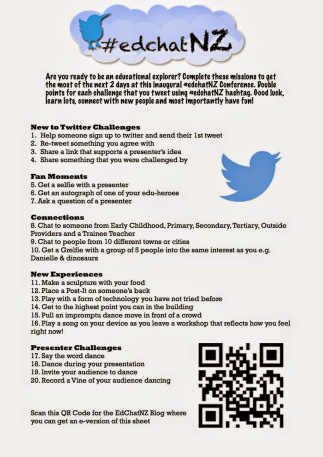
3.How many #Edchatnz challenges did you complete?
1, 2, 3, 4, I missed out on 4 because I was too nervous to ask for one with +Pam Hook (@arti_choke) and too much of a fan girly mess to ask for one with +Danielle Myburgh (@missdtheteacher) and too in awe of my amazing friend +Ros MacEachern (@rosmaceachern) who I learnt loads from to ask for one with her either. I am usually totally selfie trigger happy. Was way too overwhelmed and overjoyed to be there.

Did 7, possibly did 8 but not sure, probably did 9 but again not sure, I was in a Grelfie with a tonne of #edchatnz Tweachers which was taken by +Steve Mouldey (@geomouldey) - does that count?

4. Who are 3 people that you connected with and what did you learn from them?
Ros, Danielle and +Matt Nicoll (@mattynicoll)

Ros - SOLO, big projects, the Brave world in which we work in everyday, how the curriculum doc is set out in particular areas in which we can then assess and work within, life lessons from my Twitter EduHero and also some fabulous insights into how to do assessments better.
Danielle - embracing the lone nut, being proud of what I've achieved thus far, that I can become a complete fangirly jumping and nearly crying mess when first meeting her in person. lol. :) Thanks for being as excited to meet me too, saying "Alex Le Long!" and hugging me - it made the entire experience so much more amazing :P
Matt - embracing the crazy and doing it anyway (onesie time), importance of being the lone nut and dancing anyway because everyone supports each other, that in a crowded room of Tweachers meeting f2f for the first time - he can make me laugh at myself like I do at home when he says something witty and hilarious - in the way where I use too many Um's - "Got that Alex?" haha.

5. What session are you gutted that you missed?
Jeez. Can I just say all of Friday? Um... Maurie's keynote sounded amazing. Would have liked to talk with Andy Schick and the people from Netsafe. Would have liked to have caught up with Catherine Delahunty again too.

6. Who is one person that you would like to have taken to Edchatnz and what key thing would they have learned?
I'm choosing four people - 
My principal - so she could see how big this thing is. And so she could understand why I was a bit (okay a lot) heartbroken at not being able to go on the Friday - and also so that she could be exposed to the amazingness of our education revolution :)
The DP in charge of IT - so she could meet some of the amazing people I connect with on a daily basis and begin using her Twitter account more effectively :) She has passion and has the ideas and the ways to implement it - but having advice from others who have already done it would be beneficial for her I think :)
My amazing friends Clare and Jane - Clare is a new teacher and Jane is an experienced teacher. Both would have loved this experience and gained so much from it.
Next year! :P

7. Is there a person you didn’t get to meet/chat with (F2F/online) that you wished you had? Why?
Yes! Loads!!!! But I was truly gutted to miss two in particular - Micheala Pinkerton (@kaiako_nz) and Toni Cliffin (@tcliffin).

Because I've talked to both so much online and they've helped me HEAPS! :)

8. What is the next book you are going to read and why?
Pam Hook's textbooks - my amazing HOD bought them for us last term when I kept going on and on about how I wanted to learn about SOLO and I only ever read bits and pieces. Now that I've got the SOLO bug again I reckon I'll be able to chew through them quickly :)

9. What is one thing you plan to do to continue the Education Revolution you learnt about at #EdchatNZ?
Keep smiling and be the lone nut. Allow myself to help others to integrate tech into their classes and be positive and supportive when they ask for help or acknowledgement of their changing growth mindsets, stay humble and don't get a big head about what I do on Twitter and how many people came up to me to thank me for being inspirational. I truly appreciate all of those comments - they floored me. Each time. Mainly because I don't see what I'm doing as inspirational - it's just what I do. And also because your toughest critic is always yourself :P

10. Will you take a risk and hand your students a blank canvas?
Always. :) Did just that today - well kind of. I need to get better at stepping right back and letting the learning happen organically because my students are amazing :)

Who will I tag with this meme: