Showing posts with label stressed. Show all posts

Sunday, 22 March 2020

2020: Pandemic Planning

Pandemic

Adjective:
 (of a disease) prevalent over a whole country or the world.
synonyms:widespread, prevalent, pervasive, rife, rampant, epidemic;

Noun:
an outbreak of a pandemic disease.
"the results may have been skewed by an influenza pandemic"

I really didn't think we'd be getting right into Pandemic Planning at kura so early. I thought maybe we'd hit global Zombie Apocalypse first... but no. This is real.

I was in a state of panic yesterday.

I spent a lot of time in bed - worried, concerned. Sleepy.

Today, I got back into action mode. Lots of things were completed at school but there is still this overarching sense of impending doom to calculate and maneuver around.

My current thoughts are a resounding: We got this! But my internal conflict says... Do we? Like actually, do we?

It makes me think about how lucky we are here in New Zealand. We'd heard about it late last year, on into the beginning of this year.

One of my Y12 students even did her speech on this subject. Only slightly ironic that we'd then have a global pandemic on our hands...

Still, all the planning in the world couldn't prepare us for this. At present we have sixty-six confirmed cases of Coronavirus. This man in the video below is so clearly spoken, so relaxed and calm in this growing sense of panic that the rest of us are feeling. People are panic buying toilet paper. TOILET PAPER. Yes.... And not just here, either. All over. Sure, hand sanitiser and bleach sold out quickly too. They've only recently put a limit on how many loaves of bread you're allowed to buy. My friends are having trouble buying bags of flour. It makes me a tiny bit more appreciative of being gluten free.

Underneath all this bravado and my own sense of supposed calm. There is an overwhelming worry and concern for the people I love and care for. My immune-compromised colleagues are allowed to work from home this week according to Ministry of Education and Ministry of Health guidelines.

We're at Pandemic Alert Level 2 here in NZ. Our schools won't close until we are at Level 4. This is in itself quite a stressful time. We are on the frontline: teachers, nurses, doctors.

What are the symptoms again?

Coronavirus has spread fast. From Wuhan, China and then on throughout the rest of the world. We closed our borders relatively quickly. Thankful to have the cousin Jacinda as Prime Minister. She has truly helped keep the virus at bay. People traveling were meant to self-isolate. I'm guessing the 66 cases are people who did the travelling.

We are yet to move to community transfer. When that happens... I guess we'll be rising to the next Alert Level.

Italy has become the new epicentre of the virus. It is awful to think of the beautiful places I travelled to and visited in 2018 having their beautiful people getting sick and dying from this disease. Apparently the canal waters are clear. The sediment has not been disturbed. Fish and swans can be seen in and on the canal waters. Even dolphins have returned.

Some are saying that this is Mother Nature's way of putting us all into a time-out. Perhaps this is true. We were going to end up this way at some point, why not now?

It's hard to say what might happen next.

All I do know is that I have to keep a calm face and encourage my colleagues to do the same.

We're all in this together. Solidarity. Sick?

Whatever it means - we have to keep moving.

It is scary though to think of my students getting sick and coming to school, sick and then that virus transferring to others.

Usually when I start thinking of next possible situations, the worst possible situations, I feel a sense of dread, panic and fear.

At least with this pandemic of Coronavirus... I know the realities. Everyone I know and love could die. This might be a really morbid thing to say - sure. But I've actually never felt more calm. Because this is literally the worst thing that could happen.

And yet, I think the panic lies in what to sort out first. Which priority is more important?

Which task on my to-do list needs to be actioned first?

To Do...


  • Ensure all classes in my department have Google Classroom set up
  • Ensure that all students have access to wifi, data or other means to complete their work
  • Check in with the immune-compromised teachers in my department. Are they okay? Will they be working at home this week? 
  • Talk with immune-compromised students via email. Check that they are ready, and set up for learning at home
  • Reassure students and teachers that it will be okay... 
  • Find out more information of how dogs can get sick from the virus... 
  • Buy more echinacea tablets ---- don't be overwhelmed if you can't find any...
  • Try not to panic buy....
  • Talk to Nan often and see how she's doing
  • Create Zoom lessons and use Screencastify
  • Prep resources that can be used online and offline
  • Talk with students and check they're prepped at home with food and safe places
  • Carry out duty at school -- enforce 2 metre separation where needed


Thursday, 12 November 2015

Reflecting on the Process of Reflection

Before I can think about how MindLab went... which was pretty well actually... I need to share a few things about how I reflect - mainly because it's on my mind and I can't quite focus til I've gotten it out of my system. Quite a few things I actually need to focus on at the moment too... like report writing, finishing marking and uploading credits to KAMAR, helping students, marking junior assessments and creating resources for them before exams next week.

Right now though, I've been prompted to think about how I reflect and how I engage with my own learning.

Even when I was younger I've always written for a purpose. When I was five it was to simply write down how I was feeling and get issues off of my chest... seemingly like what I'm doing now... When I was 11 - 15 I started thinking about the people who might actually read these diaries I was writing - my children, grandchildren, family etc - and I wrote as if I was writing to them, even talking to them by names I'd made up. When I was 16 I fully embraced the fanfiction world and became so involved with it because of my escapism so as not to think about the reality that I was living without my Grandad. I didn't really write much for a while about myself in journals as I was expressing myself through badly worded lyrics, poetry and continuing to make my way as a creative writer in the fanfic world. From 18-20 I was so immersed in the beautiful philosophical reality of being at university and learning so much about myself and sharing my ideas through essay after essay. I was also struggling with being in the parallel and very unsure world of meeting my Dad, brothers and sisters and distant members on my dad's side of the family tree. When I was 20... something incredibly terrible happened at the time that prompted me to begin writing again. I'm glad I did because I haven't stopped since.

Whether it's been in little kid diaries, silly LiveJournal posts, KiwiBlog, Blogger or private writing in unpublished blogs - I've been aware of who my audience was.

At present, I write for myself here. I know that there is a bigger audience that reads this - and I'd just like to make a shoutout to the MindLab 2015 Nov intake crew who commented a few posts ago and reminded me that people do read my stuff!! :)

Regardless though, this is always and has always been a reflection of my own teaching journey within this blog. I'm a curator of knowledge. I gather what I need, search for what I want and develop my own theories and hold onto information that happens to help me live the life I'd like to and that helps me with succeeding in my aspirational life goals.

As a curator, I like to share. As evidenced here and on Twitter too....and Facebook... where I post a lot...and share cool things I see. I didn't connect with the word curator until last year when a new colleague from Australia mentioned during a conference that I was prolific with how I share. I'm sure that there is another word he used but right now it's not falling into thoughts from the words hanging in my head...

As a curator, like good museum curators (which I'd love to be one day too..), I think about the story I need to share, the perspectives I'd like people to think about and more importantly, the understandings that develop and are created over time.

As a curator I think about what to post, what to share and obviously what not to share. People have different ideas on this of course.

On Twitter, I'm very sure of the how, what and why when using it and more importantly with who I'm discussing things with. The tikanga of Twitter helps when deciding what to share and when and with what audiences and this could be as simple as which hashtag to use. I think though that the fact that it's so public is what keeps me being true to myself and I say what I believe, constantly professional (with the odd tweet to my mate...) and overwhelmingly OWN everything I say and post. If there is some issue, I'm totally okay with taking things down if they've offended someone or have perhaps been taken the wrong way and I try to deal with the situation as fast as possible and with as much care as I can. Sometimes it can be easy to be a different person behind the screen than it is to show your true self. Portraying yourself and being transparent is key.

At the end of the day - I'm me and I'm constantly learning. I hope I never give up and become cynical and believe that change is hard. Because it's not. It's uncomfortable. And regardless of how carefully worded I pitch things as new ideas, there will nearly always be someone who doesn't agree or want to give it a go.

At the end of the day - I know who I'm writing for. Who I am and who I want to be. I need reminders like this that maybe if there are disgruntled people that perhaps I'm doing my job of being a change agent and disrupting with humility. I just need to be careful not to get in a rut, stuck, trapped into thinking that what I'm doing doesn't have a purpose or that what I'm doing is unworthy. Because I'm proud of where I've come - particularly since I was 20. Seven beautiful years... well maybe lets say six - but regardless... still proud of myself. Making movements towards the person I want to be one day and every new step, every new challenge, is at least hopefully moving me in the right direction.


Wednesday, 2 September 2015

Celebrating Success

A colleague mentioned at our S Club meeting that she celebrates every little achievement that the students achieve.

I loved this. Because I used to too.

We were discussing the need to create a new exam for the students especially in the S classes because having had such positive growth minded students last year who just pushed themselves so so hard and did the best they could possibly do in their end of year exam... and fail miserably was heartbreaking - for me and for them.

I don't like the idea of streaming but it's a necessary evil in some ways. The point I was trying to make then at the meeting as I am now is that we needed to ensure our students didn't feel like that again. Because as you know- it has a flow on effect to their motivation and self-belief year after year. And if we're making them think they already suck at Y9 and 10... then how is that supposed to encourage them? My main issue is that the exam seems more weighted towards the higher end of the streamed classes so that we as a department can skim the top level for the Cambridge classes in Y11.

I just don't think it's fair nor is it equitable for a small amount of kids to be actually succeeding and for a majority to feel like they're failing. When a 40% mark is the highest mark your students can get in your class... there must be something wrong.

Because my students knew their stuff. They busted their little bottoms off to get the knowledge they needed and push themselves. But it still wasn't enough.

I don't want to set my students up for failure again and have been doing everything I possibly can to ensure they won't feel like failures - that they'll know some answers and can explain in their own way their connection and response to text.

At that point in the meeting my colleague says that we shouldn't be just gearing them up for the exam - and while she's completely right - the systems we have in place within education ensure that that is our main focus.

And so she continued explaining how she celebrates every little success. And it was just what I needed to remind myself to continue doing what I once did. Why have I changed? I don't know. But I miss that super positive person who believed in every student and wasn't so jaded by reality and burnt out by trying to motivate those that just refuse to motivate themselves.

It's a bit sucky because my juniors miss out on my best teaching because I have three senior classes - a y11L, y12L and y12A.   The L classes are the 'normal' courses and the A is the 'alternative' course where they do one less external...

Because of the amount of motivation and continual pressure I put on my students to try and get them through internal after internal to keep hunting those credits - we often end up losing the true importance of education - actually learning.

And this is what I've been trying to do more of within my junior classes - learn. And they've actually been my saving grace to be honest. In the junior classes I can laugh and relax and be me and teach the way I love teaching - to the students in front of me and ensuring they all have a co-constructed input towards what we're doing.

In senior classes it just really is not that easy. I feel constantly at battle with lack of motivation, the need to always refocus and monitor my students work output, to ensure they are always handing me in their work or showing me how they're going nearly every day so I can keep pushing them along to the achievement line of external exams. This is draining and it makes my head hurt and my heart ache. Because I know it's not meant to be like this.

We've gone so far away from authentic learning that we have mere glimpses of teachable moments and constant credit tracking to reach the targets.

So..  I guess what I'm trying to get at is that I miss celebrating the small successes - because every single time my students learns something new and that lightbulb FINALLY goes off in their eyes - it makes me joyful - if only for a moment.

I will laugh more with my seniors. They hardly ever hear me laugh. I will be myself and allow the pressure and time limits to wash over me and teach what I must to ensure they're ready... but teach the skills first and foremost and the content too with a possible endgame of credits as a sweetner - but by no means the point of learning.

I will relax with my juniors because if I get them ready enough I won't have to worry about them next year.

I will try to be more onto it and focussed and take time for myself.

Lastly - I will remind myself to celebrate each and every success my students have - small or big - because to them and me - success is success and it should be celebrated.

Wednesday, 3 June 2015

Mid-Year Self Reassessment

The last few days I've been thinking about that dreaded word: burnout.

To burn out as a teacher means to have nothing left of yourself. You've given all that there is to give and you've basicallt got nothing to carry on with.

My biggest worry always is that I do too much. I do a lot because I have the time, the passion and the interest.

There is the illusion of more time because PI is over for the year. Girls Rugby has been cancelled for the year. There is no conference to organise. No immediate stress.

However, on a daily basis I help out with different things.

Offering to do one on one tech support sessions
Offering to present at upcoming conferences and PLD sessions
Sharing my ideas online
Making worksheets and infosheets for those who need them
Preparing eLearning workshops
Sharing ideas at school in meetings and f2f
Moderating twitter chats
Promoting chats and what I'm doing online
Upkeep of my portfolio, class site, eLearning hub, twitter, G+, FB, blog
Developing new collaborative and co-constructed ideas

Then of course there's my actual job of being a teacher - where I'd much rather spend all my time looking at developing my own teaching style, incorporating my ideas about tech into my class and ensuring that it is actually helping my students. All of this is burdened by the many different initiatives and admin we are required to do also.

I feel like this is the time to reassess. Is what I'm doing outside of class actually helping my students in my own classes? Surely. But I need to spend more time on me with planning, and learning how to be the best teacher I can be. I've set up easier planning with G Calendar so that's not the issue. It's not even the marking because that's doable too. It is difficult at times because I don't have access to my class except during intervals and lunch but then students come in then for help or just to talk.

What can I be doing better or at the very least differently that would make my student's outcomes better?

Ensuring more focussed assessment tasks for my juniors. Developing a method of collecting in, marking, handing back, moderating and marks being added onto KAMAR in a much more timely manner. Improving my class environment so that it's interesting and not messy. Yes - working spaces and all that - but it's still not setup how I want it. I need more time to do this. The desks have stayed in the same structure for ages now. Perhaps they need altering too.

When it comes down to it - I love teaching. I love teaching my students and my new passion is teaching other teachers and coaching them through their eLearning journey.

I just need to make it manageable. Strip it back to the bare essentials and focus on what I actually need to do and what can be organised and facilitated.

Big concerns:
Figuring out how to deliver PLD properly to the staff. Apparently it was going too fast still. And I seriously thought I was going slowly. I need stronger and more specific feedback and feedforward of what they need.
Ensuring staff know how to turn off G+ notifications and organise their Gmail so that they don't get overloaded.
Developing a shared plan in moving forward for PLD
Catching up on Interlead reflections. School wide.

Saturday, 7 March 2015

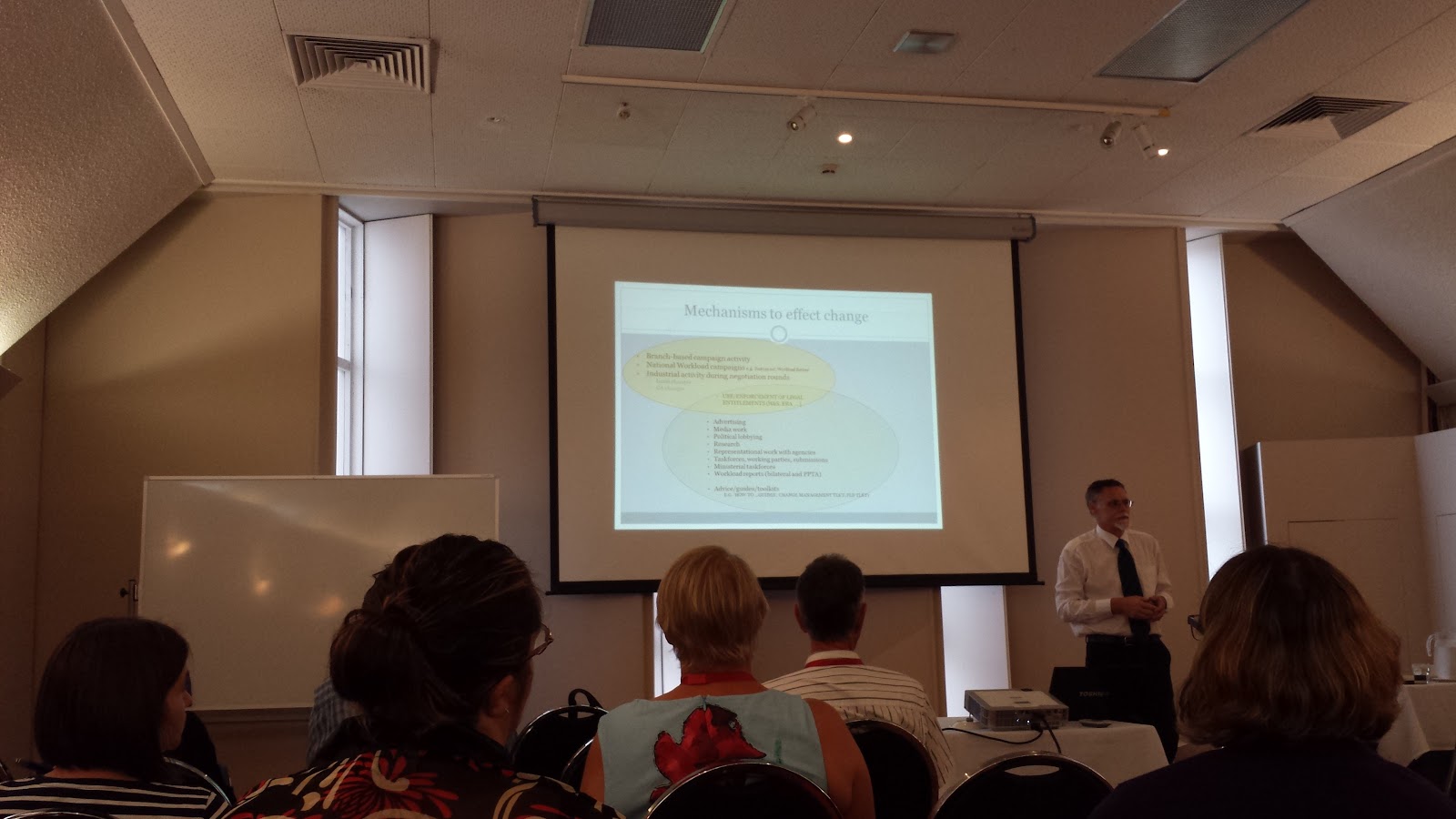
Workload Protections - A Quick History of Provisions: Rob Willets - PPTA Issues and Organising Conference 2015

Workload Protections - A Quick History of Provisions
Rob Willets

1991 - Codification

  • Any non-contact time by grace and favour and practice of school
  • 23 hrs pw teaching common but could be 25
  • First yr teachers could teach up to 20 hpw
  • No class size constraints
  • Te Atakura grads from 1987-1990 recieve a time allowance
  • Taching wk 10 half days (effectively 25 hrs)
  • Teaching yr 380 half days

Claim and campaigns
  • workload
  • class size
  • mac contact time
  • max classsize
  • max 500 student hpw contact claim
  • Max hrs per year claim

No movement on provisions in the 1990s but pressure built up to address workload issues.


2015-03-07 15.35.25.jpg

1996 STA settlement
PLD call-back when school closed for instruction limited to 5 days p.a (w reimbursement consts)

1999 STCA settlement
Limit call-backfor admin when school closed for instruction

2000 SSRG
School Staffing Review Group 2000 - PPTA secures 1,800 FTTE extra staffing for sec and area schools - sufficient to resource 20 hrs max contact and an hr per unit
2001 claim for max contact time of 20 hrs
Mallard “over my dead body” - PPTA members decide this is the scenic route
Significant industrial action 2001-2002

2004 STCA
From 2006 min 5 NC hpw for full-timers
Y1 - 15hpw contact time
Y2  - 17.5 hpw contact time
1hpw per permanent unit (up to 3)
Table of min non-contact hpw for part-timers 18hpw and above (not prorated)
Medical retirement
Sabbatical scheme

2011 STCA settlement
HoDBTTA extended - 1hpw per Y2PRT with BTTA
Ten new 10 wk senior manager sabbaticals pa
Sec sc staffing review group

2012 Staffing Cuts Fight
Govt policy to cut staffing and increase class sizes at junior levels reversed. “90% of schools will lose or gain no more than 1 FTTE”
  • Resourcing
  • Information
  • Lobbying
  • Political
  • Media

1990-2015 Claw Backs
There have been aggressive employer claims around workload during industrial rounds in the 1990s and since 2007
etc


Next phase 2015-2018

Claims dev process

  • Teacher Workload Taskforce - What is the most effective change to make to fix the workload problem? We need to have a really good idea of what our individual issues are with workload and think about what the symptoms and solutions are for these.
  • Review of Work of the Middle Manager

  • Media work
  • Political activities
  • Lobbying
  • Representational work
  • Use of other legislation (eg. H&SA)

2016/17/18 claims -  Need to start thinking about future claims and process within this


Human Rights and Stress in the Workplace: Yvonne Oldfield - PPTA Issues and Organising Conference 2015 - Workshop

Human Rights and Stress
Yvonne Oldfield

Are Labour Rights Human rights?
Normative - something that is inherently right, has a moral force or absolute value
Something you don’t have to bargain for or fight for. A normative right is something that is a given.

“A human right is not earned or legislated into existence and cannot be bargained away… it attaches to the very fact of being human.” (Hugh Collins/Virginia Mantouvalou)

Moral weight - health and safety goes to issues of survival.. a facet of … “inalienable facet of life.”
Universal application - must apply to everyone. We are all workers or potential workers
Stringency and timelessness - accept that no activity can be entirely risk free

Uni of Dec on H R (1948)

Right to work (article 23):
  1. Everyone has the right to work, to free choice of employment…

International covenant on Economic, Social and Cultural Rights
  • Right to work
  • Right to safe and healthy working conditions
  • social security
  • etc

Health and Safety and the ILO
  • Millennium Dec… Decent Work Agenda
  • Seoul Dec (2008)
    • Safe and healthy work environment - human right

Defining the right -

“The right to work in an environment reasonably free from predictable, preventable, serious risk” - Spieler

What does this mean in practice?
  • stress: personality differences, the idea that you are to blame,
  • physical: short and having to stand on tables,
  • workload:
  • Communication breakdown: SMT to Staff, HOH and Teachers, Teachers to Teachers, holistic
  • Extra-Curricular and Extra Opportunities for Ss. Expectation that you should do it.
  • responses put us at risk, “teacher just needs to harden up”,
  • Unacceptable behaviour
  • Feel stressed when our response taps into physiological and psychological stress
  • Situation will affect everyone differently -
  • Minimise risk -

Difficult to define the expectations and the responsibility and blame for stress.

The need to have a Health and Safety rep at school.
The need to have support networks
Boards should have a policy.
Process needs to be really clear: identify hazard or problem - who to talk to - knowledge that they’re going to deal with it.

What are the key elements of the right?
  • Predictable?
  • Preventable?
  • Serious?


Who are the “duty holders” - who is responsible for ensuring that this right is upheld?

  • Everyone -
  • ERO - identifying that conversations

Elements of the right:
  • Rights to information about the dangers on the job (goes to worker control/informed choice)
  • Freedom to protest or refuse work (level of risk may change over time, or new information become available)
  • Worker participation (Robens model predicted on full engagement by workers)

Discussion:
For new teachers this is HUGE. We feel too scared to say that we’re overwhelmed because we’d be looked as if we were incompetent.

Not speaking up. Scared you’ll lose your job. Lost to the profession. Not compensated. We’ve lost teachers from heart attacks. Stress can be fatal.

Stress in Teaching:
Teaching has always been considered stressful - research by England’s Health and Safety Executive, found it to be one of the most high-pressure careers, with 41.5% of teachers reporting themselves “highly stressed”. www.the guardian.com/education/2012/dec/26/teachers-stress-unions-strike

The Role of the State: monitoring and enforcement:
Maastricht Guidelines: States must acknowledge legitimacy of rights and meet obligations to:
  • Respect (don’t undermine workplace safety)
  • Protect (set standards to prevent violations by third parties) and
  • Fulfil (monitor/administer/enforce to ensure the realisation of rights).


What are the health and safety issues for teachers?

Specifics on Stress:
  • increased workload
  • being asked to now perform extra initiatives beyond training (academic mentoring, guidance counselling, negotiators, policing students)
  • expectation of being available 24/7
  • fast paced initiatives that don’t really change anything though they are pushed out as if they will change everything
  • diversity of student behaviour - expectation to fix it
  • personalising of programmes
  • HOD - extra legislation to ensure..
  • Middle Management and senior mngmt are sometimes bullies, tell you to suck it up, build a bridge and move on
  • PPTA expectations and having to fight for our rights as teachers and as workers
  • Data gathering
  • ADMIN: academic tracking sheets
  • Building portfolio for appraisal
  • Engendered by increasing vulnerability of fixed term contract, casualty of the workplace
  • constantly having to be on top of behaviour
  • Restorative Justice: restorative chats to get things sorted, missing out on breaks, becoming seen as a bad teacher for taking your breaks
  • Can’t say NO. The mechanism for relieving stress is creating stress
  • Under more pressure to keep up with tech and expectations of the digital load
  • Erosion of work/life balance
  • Mentoring -
  • LACK of TIME.
  • Time pressure
  • Given an extension of form class to do academic counselling - track it on KAMAR. Checking up on us for not doing our job
  • Hekia saying we need to raise the bar all of the time and what we need to achieve
  • Summer school
  • Extra classes, more credits, “Can’t you find a Unit Standard for them to do during the holidays?”
  • If you follow procedures, sometimes it doesn’t work and then it’s not followed through.
  • The tension of when a teacher can reasonably say NO. Or question the situation.

Who?
  • Govt?
  • BOT?
  • PPTA?

Information is a key issue. But if you don’t know where to go with it or whether it will be followed up - then what will happen?

What is workplace stress?
  • “work-related stress is the response people may have when presented with work demands and pressures...which challenge their ability to cope.
  • Stress occurs in a wide range of work circumstances but is often made worse when empoyees feel they have little support from supervisors and colleagues as well as little control over work processes
  • There is often confusion between pressure or challenge and stres and sometimes it is used to excuse bad management practice.”

Solutions:
Survey to be created and sent out to branches

Workload Taskforce: paper version has been done. Digital survey to be created and all schools will be doing it this term. Encourage your colleagues to do it.

Need to tie in consequences. Need to show the outcomes of people with health issues.

What are the health issues that flowed with stress levels.
Need exit surveys when people leave schools.


What might a safe system of work look like?
How can we:
Prevent (Eliminate)?
Reduce (Minimise)?
Manage?
Cope?

With stress and violence in schools?


OUR thoughts: It is too individualised. Those who have the stress need to say that they’re stressed and feel comfortable in their workplace to be able to do so. Access the tools available to them individually.

The main problem is that people don’t feel able to stress out.

Group discussion:
When new initiatives are introduced - a RAMS audit should be done. If staff were consulted then risks would be reduced. Something has to be taken off. Layer upon layer upon layer. “What is this replacing?” You may only do it for a couple of years (the money is gone) and all of your hard work is gone. How are you going to show that it’s working?Measure effectiveness. Need to measure effect of initiatives. Never any evaluation of the initiatives brought in and how effective they were.

More support needed for eLearning. Include use of volunteers. What is effective of modern learning?

Abide by the contract.

Nurse/other specialists not able to help staff.

Limits on work time - start by measuring hours.


Preventing stress in schools…
  • develop a constructive workplace culture based on decent work, professional respect, basic health and safety principles, tolerance, equal opportunity, and quality of service
  • Promote a culture of school or organizational healthiness - redesigning work, ergonomics, teacher training and counselling to assist teachers in coping
  • Implement safe schools policies and programmes including clear statements that violence will not be tolerated, and
  • Recognise and assess serious student behaviour issues; intervene, monitor and evaluate

Handbook of good human resources practices in the teaching profession, ILO, Geneva 2012